

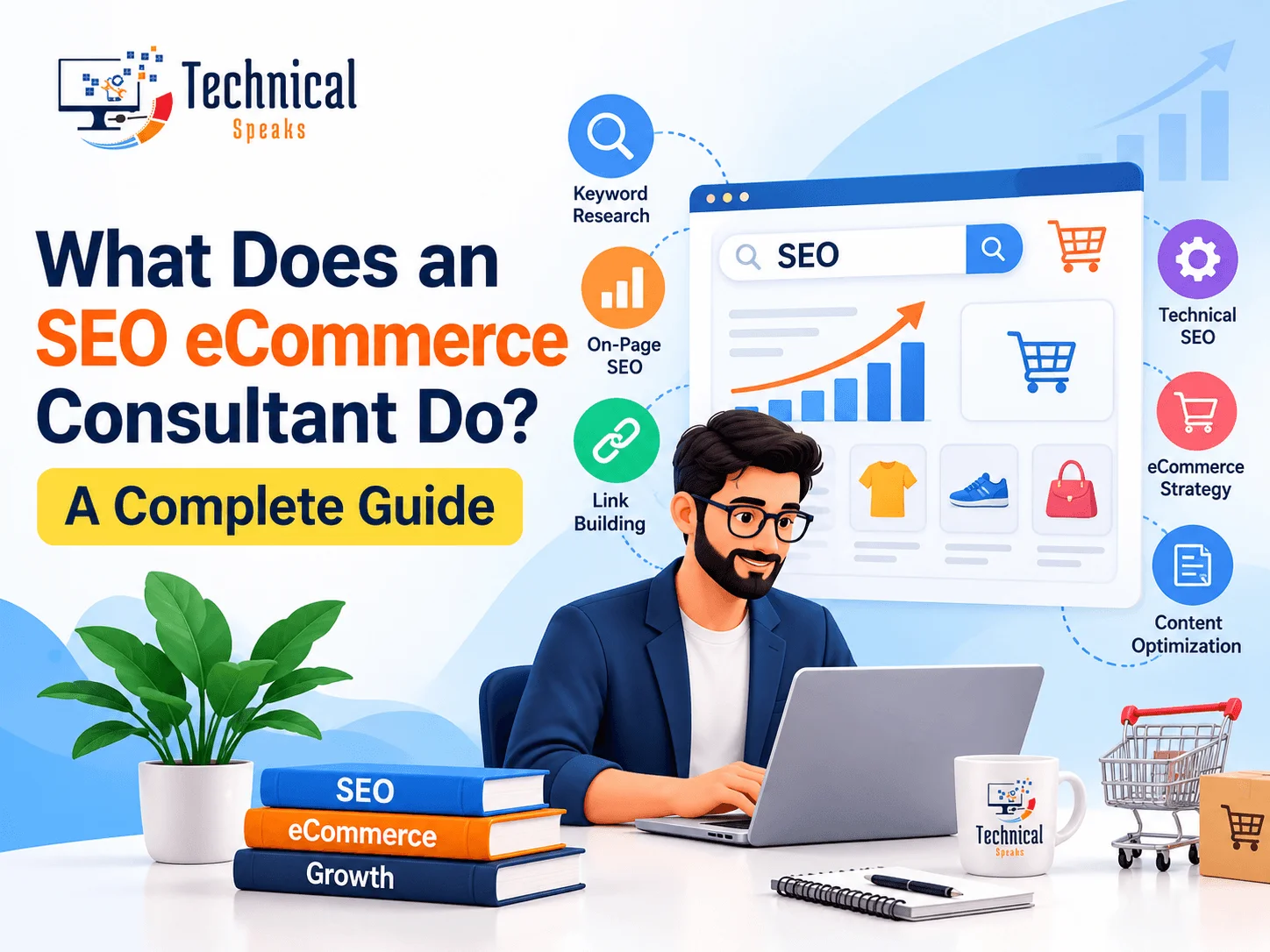
An ecommerce SEO consultant helps online stores get more sales from search. They fix technical problems that stop products from being found and optimize product and category pages. They target keywords that real shoppers use, and they make sure your products show up in Google Shopping and AI shopping answers. They measure success in revenue, not just rankings.
Online stores have problems most websites don’t. They deal with thousands of product pages, filters that create duplicate URLs, products going out of stock, and competition from Amazon and big retailers. That’s why ecommerce SEO is a specialty of its own.
If your store gets traffic but not enough sales, or barely shows up at all, here’s what a consultant would actually do and how to tell if you need one.
What an ecommerce SEO consultant focuses on
A store can rank #1 for “what is a running shoe” and sell nothing. A good consultant cares about buyer traffic: people searching for “women’s trail running shoes size 7” who are ready to purchase.
Their work usually covers six areas:
- Technical SEO for large catalogs
- Keyword research based on purchase intent
- Product and category page optimization
- Shopping and AI search visibility
- Content and links that support sales
- Revenue-focused tracking
1. Technical SEO for online stores
This is often where the biggest wins hide. A consultant will look at:
- Faceted navigation: filters for size, color and price can create thousands of near-duplicate URLs. The fix is deciding which filter pages deserve to rank (like “black leather boots”) and keeping the rest out of the index.
- Crawling and indexing: making sure Google spends its time on your products and categories, not on endless parameter URLs. A clean XML sitemap helps.
- Site speed and Core Web Vitals: heavy product images, apps and scripts slow stores down. Here’s how Core Web Vitals work. Most consultants start with a full technical SEO audit.
- Product structured data: price, availability, reviews and shipping details marked up so they can appear in search results.
- Platform issues: Shopify, WooCommerce, Magento and BigCommerce each have their own quirks with URLs, duplicate collection paths and apps.
- Out-of-stock and discontinued products: temporarily out of stock usually means keeping the page live. Discontinued products may need a redirect to the closest replacement, or a page that points shoppers to related items.
2. Keyword research for buyers
Ecommerce keyword research maps searches to the buying journey:
| Stage | Example search | Best page type |
|---|---|---|
| Research | “how to choose running shoes” | Buying guide (blog) |
| Comparison | “best running shoes for flat feet” | Comparison guide or category page |
| Ready to buy | “nike pegasus women’s size 7” | Product page |
A consultant prioritizes the searches closest to a sale and maps one main keyword to each page, so your own pages don’t compete with each other. They also study what’s working for competitors, using SEO competitor analysis.
3. Product and category page optimization
- Category pages are often your strongest ranking pages. They need a clear H1, a short helpful intro, good filters and internal links to subcategories.
- Product pages need unique descriptions (not the manufacturer’s copy every other store uses), clear titles, specs, sizing info, real reviews and good images.
- Templates at scale: for big catalogs, the consultant builds title and meta templates that work across thousands of SKUs, then hand-tunes the top sellers.
- Images: descriptive file names, alt text and compressed files. See our image SEO guide.
Our on-page SEO checklist covers the basics for every page type.
4. Google Shopping and AI shopping visibility
In 2026, a lot of product discovery happens outside the classic blue links.
- Google Merchant Center: a clean product feed gets your items into free product listings on Google Shopping and other Google surfaces.
- AI shopping answers: Google AI Mode, ChatGPT and Perplexity increasingly suggest products. They rely on clear product data, honest reviews, detailed specs and trustworthy brand signals. Learn how AI answer engines choose sources.
- Marketplaces: some consultants also optimize Amazon, Walmart or Etsy listings, which have their own ranking rules.
If you also run Shopping or Performance Max ads, your SEO consultant and ads team should share the same feed. Here’s how to choose search engine marketing consultants.
5. Content and links that support sales
- Supporting content: buying guides, comparisons, size guides and care tips that answer questions and link to products.
- Link building: product reviews, gift guides, supplier and brand mentions, and digital PR. More in off-page SEO for ecommerce and how to create high-quality backlinks.
- International growth: stores selling abroad need hreflang, currency and local content. See international ecommerce SEO.
6. Revenue-focused tracking
A good consultant reports on organic revenue, conversion rate and average order value, not just traffic. They’ll set up GA4 ecommerce tracking, connect it with Search Console and show which pages and keywords bring in sales. Here’s what a useful SEO report looks like.
Signs you need an ecommerce SEO consultant
- Organic traffic is flat or falling, and you don’t know why.
- Your products don’t show up in Google Shopping’s free listings.
- Search Console shows lots of pages “crawled but not indexed.”
- You use manufacturer descriptions across most products.
- You’re planning a platform migration or redesign.
- Competitors with weaker products outrank you.
- You get traffic but very few sales from organic search.
If three or more of these sound familiar, an audit is worth it.
What the first 90 days usually look like
| Timeframe | Typical focus |
|---|---|
| Weeks 1–4 | Technical audit, tracking setup, keyword and page map |
| Weeks 5–8 | Fix top technical issues, optimize top categories and best-selling products |
| Weeks 9–12 | Content plan, feed and structured data cleanup, start link building, first results review |
Bigger results usually take longer. Technical fixes can show impact within weeks, while competitive category rankings often take several months.
Ecommerce SEO consultant pricing
Prices depend on catalog size, platform, competition, location and how much hands-on work is included. Common models are:
| Model | Best for |
|---|---|
| Hourly consulting | Strategy calls, quick audits, second opinions |
| Project fee | Full audits, migrations, launch setups |
| Monthly retainer | Ongoing optimization and content |
| Agency retainer | Large catalogs, multiple channels and markets |
| Base fee + performance | Stores with clean tracking and clear revenue goals |
Get two or three written proposals for the same scope, and be wary of very cheap offers. They often rely on shortcuts that can lead to a Google penalty. If you’re comparing agencies in India, see our list of SEO service providers in India.
Questions to ask before hiring
| Question | Good answer sounds like |
|---|---|
| Which platforms have you worked on? | Specific experience with yours |
| How do you handle faceted navigation? | A clear plan, not “we’ll noindex everything” |
| Can you show organic revenue results? | Case studies with sales, not just traffic |
| What will you do vs our team? | A clear split of tasks and who implements |
| How do you report? | Monthly, with GA4 ecommerce and Search Console data |
FAQ
What does an ecommerce SEO consultant do?
They improve an online store’s visibility and sales from search by fixing technical issues, optimizing product and category pages, targeting buyer keywords, cleaning up product feeds and tracking organic revenue.
How long does ecommerce SEO take to work?
Technical fixes can show results in weeks. Meaningful growth in competitive categories usually takes several months to a year.
Can I do ecommerce SEO myself?
For a small store, yes, if you learn the basics. Start with our ecommerce SEO guide. Large catalogs, migrations and faceted navigation usually benefit from an expert.
What’s the difference between a consultant and an agency?
A consultant is usually one expert or a small team focused on strategy and often hands-on fixes. An agency has a bigger team for content, links and development, but you may get less senior attention.
Does a general SEO expert work for ecommerce?
Sometimes, but ask about catalog experience. Faceted navigation, product feeds and inventory changes are skills many general SEOs haven’t needed.
Final thoughts
An ecommerce SEO consultant does much more than tweak meta tags. They make your catalog easy for Google and AI tools to understand, put your products in front of ready-to-buy shoppers and prove results in revenue. If your store has growth potential but organic sales are stuck, a consultant can be one of your best investments. Just choose one with real ecommerce experience. And if you’re building on WordPress, pick one of these WordPress themes for ecommerce that’s built for speed.
Want help growing your store’s organic sales? Get in touch with our team today.
Saurabh K. has been working in SEO and digital marketing for 10+ years, helping businesses grow their search traffic.

Comments
Leave a comment