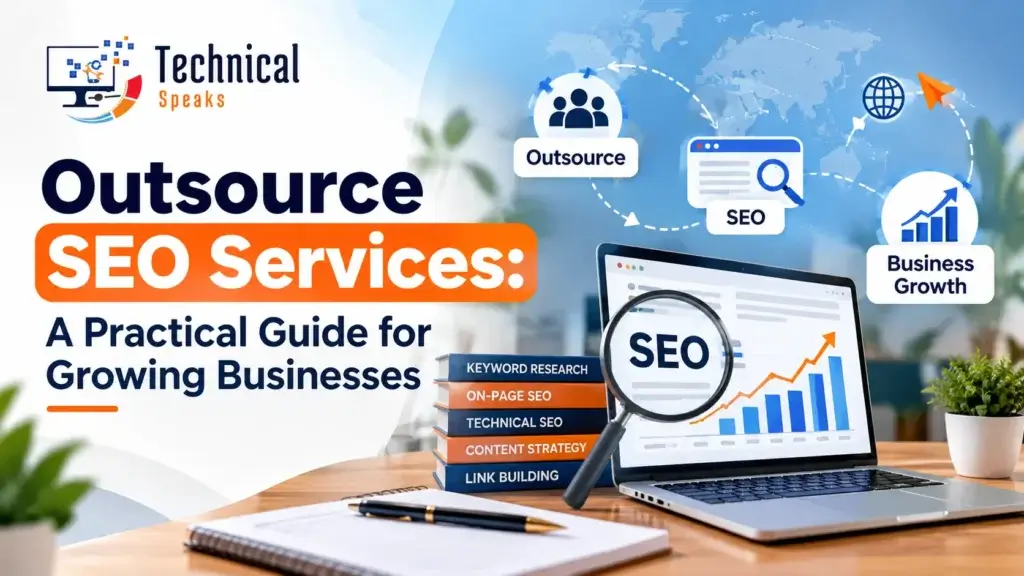
To outsource SEO services means you hire an outside agency, consultant or freelancer to handle some or all of your search engine optimization. That can be technical fixes, content, link building, local SEO or the whole strategy. It works best when you keep ownership of your accounts, agree on clear goals and reporting, and give it time. Google itself says most SEO work takes four months to a year to show results.
This guide covers what you can outsource, how it compares with an in-house team, how pricing usually works, the red flags to avoid, and how to pick a partner you can trust.
What does it mean to outsource SEO?
Outsourcing SEO means a third party does the SEO work your business needs instead of your own staff. You stay in charge of the goals and the budget. They bring the skills, tools and time.
It can be as small or as big as you need:
- A one-off project, like a technical audit or a site migration.
- A single function, like content writing or link building, while your team handles the rest.
- Full management, where the partner owns the strategy, the work and the reporting.
If you’re an agency buying SEO to resell under your own brand, that’s a different model. Our guide to white-label SEO services explains how it works.
Why businesses outsource SEO
Most businesses outsource for a few practical reasons.
- Skills you don’t have in-house. Good SEO mixes technical, content, analytics and outreach skills, and it’s rare to find all of them in one hire.
- Tools without the subscriptions. Agencies already pay for rank trackers, crawlers and backlink tools.
- Speed. An experienced team can start in weeks. Hiring and training someone takes much longer.
- Keeping up with change. Between core updates, AI Overviews and the SEO trends for 2026, search moves fast. Specialists track it full-time.
- Focus. Your team can stay on product, sales and customers.
In-house vs outsourced vs hybrid SEO
No model is right for everyone. Here’s a fair comparison.
| In-house team | Outsourced partner | Hybrid | |
|---|---|---|---|
| Knowledge of your business | Deep, day to day | Builds over time | Deep, from the in-house side |
| Range of skills | Limited to who you hire | Wide: technical, content, links | Wide |
| Cost structure | Salaries, benefits, tools | Monthly fee or project fee | Smaller team plus a partner |
| Speed to start | Slow (hiring and training) | Fast | Medium |
| Scaling up or down | Hard | Easy | Fairly easy |
| Best for | Large sites with steady SEO needs | Small and mid-size businesses, or specialist gaps | Growing companies with a marketing team |
Many businesses end up hybrid. Someone in-house owns the goals and the content, and an outside team handles technical SEO and link building.
What SEO work can you outsource?
You can outsource almost every part of SEO. These are the most common.
Technical SEO
Site speed, Core Web Vitals, crawling, indexing, redirects and structured data. Start with a technical SEO audit, and see the common technical SEO mistakes a good partner should catch early.
Content creation and optimization
Blog posts, service pages and updates to existing content. If this is your main need, here’s how to choose SEO content writing services.
Link building and digital PR
Earning links from relevant, trusted sites takes time and outreach. Know what high-quality backlinks look like so you can judge the work.
Local SEO
Google Business Profile, reviews, citations and location pages. It’s often the fastest win for service businesses. Here are the benefits of local SEO.
Keyword research and competitor analysis
Finding what your customers search for and where competitors are winning. A good partner starts with a proper SEO competitor analysis.
AI search visibility (AEO)
Search now includes AI Overviews, ChatGPT and Perplexity. Ask any partner how they help your brand get cited in AI answers, not only how they rank blue links. Our guide on what AI SEO is explains the basics.
Reporting and automation
Many agencies use SEO automation for rank tracking, audits and reports, so more of your budget goes into actual strategy.
How outsourced SEO is usually priced
Prices vary a lot by country, scope and competition, so be wary of any article that quotes “standard” rates. What you will see is one of these models:
- Monthly retainer. A fixed monthly fee for ongoing work. It’s the most common model for long-term SEO.
- Project fee. A one-time price for a set deliverable, like an audit, a migration or a content batch.
- Hourly or consulting. You pay for expert time, which is useful for advice and training.
- Performance-based. Payment is tied to results. Read the terms carefully, because “results” can be defined in ways that don’t help your business.
Whatever the model, ask for a written scope that lists exactly what’s delivered each month.
How to choose the right SEO partner
- Define your goals first. More leads, more sales, or more local calls? Pick two or three numbers that matter to the business.
- Check real case studies. Ask for Search Console screenshots and references from businesses like yours.
- Ask how they work. You want a clear plan for the first 90 days, not vague promises.
- Insist on white-hat methods. Anything that breaks Google’s rules can get you penalised. These are the black hat SEO techniques to avoid.
- Look at their reporting. A good report explains what was done, what changed and what’s next. Here’s what good SEO reports for clients include.
- Start small. A paid audit or a three-month trial shows how they communicate before you sign a long contract.
- Match the specialist to the job. A SaaS company needs different experience from a local clinic. For example, see how to choose a B2B SaaS SEO agency.
Google’s guide on hiring an SEO also lists useful questions to ask any provider.
Red flags to watch for
- Guaranteed #1 rankings. No one can promise that, and Google says so itself.
- “Secret” methods they won’t explain.
- Lots of cheap links from unrelated or low-quality sites.
- They own your accounts. Search Console, Google Analytics 4, Google Business Profile and your domain should always be in your name. Give them access; don’t let them hold ownership.
- Reports full of vanity numbers, like impressions only or rankings for keywords nobody searches, with no link to leads or sales.
- Long lock-in contracts with no exit clause.
What a good first 30 days looks like
- Week 1: Access set up, goals agreed, baseline numbers recorded from Search Console and Analytics.
- Week 2: Technical audit and a keyword and competitor review.
- Week 3: A prioritised plan, quick wins first.
- Week 4: The first fixes go live and the first report goes out, showing what was done and what’s next.
You can check their numbers yourself with free tools like Google Search Console. Here’s our list of the top 10 free SEO tools.
Example: a client’s growth with outsourced SEO
One business had inconsistent results doing SEO in-house. They handed technical SEO, keyword research, content and link building to an outside team, which started with a solid foundation based on our SEO for a new website process.
Over three months, Google Search Console showed:
- Clicks grew from 1.11K to 2.52K.
- Impressions grew from 266K to 578K.
- Average position improved from 25.5 to 16.3.
Every site is different, and results depend on competition and starting point. This shows what steady, focused work can do.
[Keep the existing Search Console screenshot here]
Should you outsource SEO? A quick checklist
Outsourcing is likely a good fit if:
- You don’t have an SEO specialist and can’t justify a full-time hire.
- You need technical or link-building skills your team doesn’t have.
- You want results faster than hiring and training would allow.
- You can commit to at least six months.
Keeping it in-house may suit you better if SEO is central to your product, your site is very large, and you can afford a full team.
FAQ
What does it mean to outsource SEO?
It means hiring an external agency, consultant or freelancer to handle some or all of your SEO, instead of doing it with your own staff.
Is outsourcing SEO cheaper than hiring in-house?
Often, yes, especially for small and mid-size businesses. You avoid salaries, benefits, hiring time and tool subscriptions. Large companies with steady SEO needs sometimes find an in-house team more cost-effective over time.
What SEO tasks can I outsource?
Technical SEO, content, link building, local SEO, keyword research, competitor analysis, AI search visibility and reporting. You can outsource one task or all of them.
How long does outsourced SEO take to show results?
Google says most SEO work takes four months to a year to show results. Technical fixes and local SEO can move faster, while competitive keywords take longer.
How do I find a reliable SEO partner?
Look for real case studies, transparent reporting, white-hat methods and clear communication. Start with a small project before signing a long contract.
Should I give an SEO agency ownership of my accounts?
No. Keep ownership of Search Console, Google Analytics, your Google Business Profile and your domain. Give the agency user access, which you can remove at any time.
What is white-label SEO?
It’s when an agency buys SEO services from a provider and resells them under its own brand. It’s mostly used by marketing agencies, not end businesses.
Final thoughts
Outsourcing SEO gives you specialist skills, proven tools and faster progress without building a full team. The key is choosing the right partner: one with real results, honest reporting and white-hat methods, who works on goals that matter to your business, while you keep ownership of your data.
Want a team that handles your SEO from audit to results? Get in touch with our team today.
Saurabh K. has been working in SEO and digital marketing for 10+ years, helping businesses grow their search traffic.