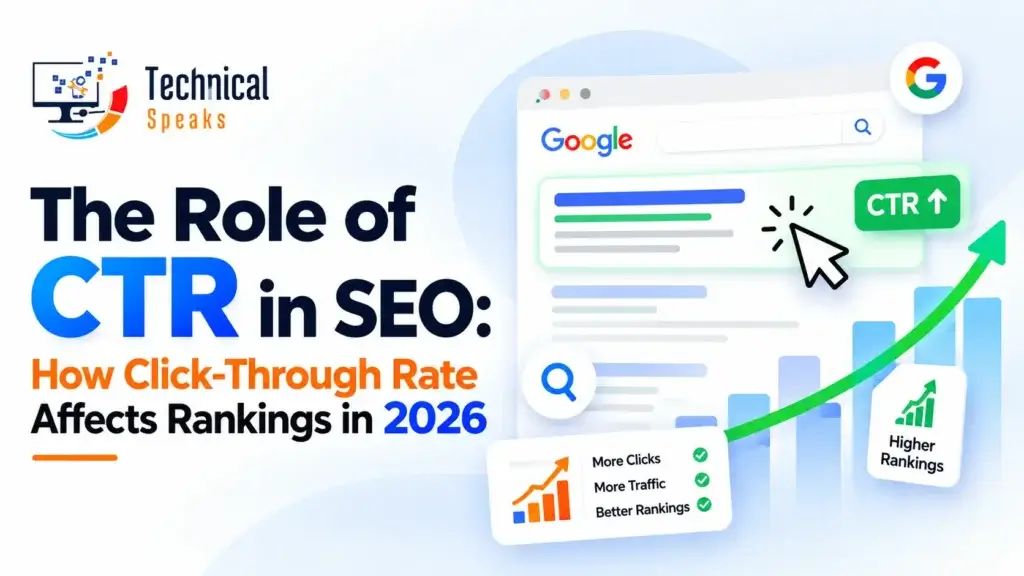
Click-through rate (CTR) in SEO is the percentage of people who click your result after seeing it in search. It matters because rankings without clicks don’t bring traffic, and because Google does use aggregated click and interaction data to help refine results. You can’t fake your way up, though.
So the real goal isn’t “boost CTR.” It’s to be the result people actually want to click, and then to satisfy them once they land.
This guide explains how CTR works, what we actually know about its role in rankings, why CTR is changing with AI Overviews, and how to improve it the honest way.
What is CTR in SEO?
CTR shows how often your search result gets clicked compared with how often it’s shown.
Formula:
CTR= Clicks/Impressions ×100
Example: if your page appears 1,000 times in search (impressions) and gets 50 clicks, your CTR is 5%.
Your CTR depends mostly on your search snippet: the title, URL, description and any extras like stars, prices or images. It also depends on what else is on the results page.
Does CTR affect Google rankings?
The honest answer: user interaction data plays a role, but not as a simple “more clicks, higher rank” switch.
What we know:
- Google has long said raw CTR is noisy and easy to manipulate, so it isn’t used as a direct, standalone ranking factor.
- Testimony in the 2023 US antitrust trial against Google described a system called Navboost, which uses click and interaction data from searches to help refine rankings over time.
- Google looks at patterns across huge numbers of searches, not individual clicks, so short-term tricks don’t hold up.
The practical takeaway is simple: write snippets that honestly match what people want, and make pages that satisfy them. That helps both your traffic and any interaction signals Google uses.
For more on how users influence results, see the impact of user behavior on SEO ranking and Google algorithms for SEO success.
What’s a good CTR?
There’s no universal number. CTR varies a lot by:
- Ranking position: higher results get more clicks
- Search intent: brand searches get very high CTR; broad “what is” questions often get low CTR
- Search features: AI Overviews, featured snippets, ads, maps, videos and “People also ask” all compete for attention
- Device: mobile results look different from desktop
- Brand familiarity: people click names they trust
Instead of chasing an industry benchmark, compare your pages against themselves and against other pages on your site that rank in similar positions.
How AI Overviews are changing CTR
For many informational searches, Google now shows an AI-generated answer at the top. People often get what they need without clicking, which means:
- Impressions can rise while CTR falls, and that isn’t always a problem with your page
- Being cited as a source in the AI Overview can still bring clicks and visibility
- Searches that need depth, comparison or action (buying, booking, how-to with detail) still tend to get clicks
So judge CTR alongside impressions, conversions and whether your page is being cited. Learn more about how answer engine optimization works, how to get cited by AI answer engines, and whether organic SEO is dead in the age of AI (spoiler: it isn’t).
What shapes your CTR
Title tag
Your title is the biggest lever.
- Match the searcher’s intent and wording
- Put the most important words first (mobile cuts off long titles)
- Make a clear promise the page keeps
- Use numbers or the year only when they’re genuinely useful
Google rewrites titles that look stuffed, vague or misleading. Clear, accurate titles that match your H1 are more likely to be kept.
Meta description
Meta descriptions don’t directly affect rankings, but they can win the click.
- Summarise what the page gives the reader
- Include the main topic naturally
- Keep it specific, not salesy
Google often writes its own snippet from your page text, so make sure your opening paragraph is also a clear summary. More on this in how search engines use meta tags.
URL
Short, readable URLs look more trustworthy than long strings of numbers. Avoid dates in URLs for content you plan to update.
Rich results
Structured data can add stars, prices, stock, images or recipe details to your result.
- Product, Review (where eligible), Recipe, Event, Video schema can all help
- FAQ rich results now show only for a small group of authoritative government and health sites, and HowTo rich results have been removed, so don’t count on them for extra space
See what changed in this major update for rich results.
Featured snippets
Winning a featured snippet puts you at the top of the page, but some searchers get the answer without clicking. See how featured snippets improve SEO traffic.
Brand and trust
People click names they recognise. A strong brand, good reviews and consistent content all lift CTR over time.
Search intent match
If someone wants a quick price and your title promises a 5,000-word history, they’ll skip it. Look at what already ranks to understand the intent, and use an SEO competitor analysis to see how others frame their snippets.
How to improve CTR (step by step)
Step 1: Find low-CTR pages
In Google Search Console:
- Open Performance, then Search results
- Turn on Clicks, Impressions, CTR and Average position
- Filter or sort pages with high impressions and low CTR
- Compare pages at similar positions; the ones with much lower CTR are your best opportunities
Step 2: Check the search results yourself
Search the main query and look at:
- What intent the top results serve
- Which features appear (AI Overview, videos, map pack, shopping)
- How competitors word their titles
Step 3: Rewrite the title and description
Example:
- Before: “SEO Tips”
- After: “SEO Tips for Beginners: 12 Simple Steps to Rank Higher”
The new version is specific, matches intent and makes a clear promise.
Step 4: Improve the page’s opening
Since Google often pulls snippet text from your page, start with a clear, direct answer to the main question.
Step 5: Add eligible structured data
Use the schema that matches your content type.
Step 6: Wait, then measure
Give changes 2–4 weeks, then compare CTR at similar positions before and after. Change one thing at a time where you can.
Use the on-page SEO checklist alongside this to make sure the page itself is solid.
CTR manipulation: don’t do it
Some people try bots, click farms or paid “click tasks” to fake CTR.
- It goes against Google’s spam policies
- Google looks at long-term patterns across many users, so fake clicks are easy to discount
- Any boost tends to vanish, and the risk isn’t worth it
More on risky tactics: black hat SEO techniques to avoid.
CTR on YouTube
CTR matters on YouTube too, where it’s called impressions click-through rate. Your thumbnail and title do most of the work. See why YouTube SEO matters and how to add keywords to YouTube videos.
Tools to track CTR
- Google Search Console: CTR by query, page, device and country
- Google Analytics 4: engagement rate and conversions after the click
- Rank trackers (Ahrefs, Semrush): positions and search features for your keywords
More options in our list of free SEO tools. If you report to clients, here’s how to create SEO reports for clients.
Example: two stores, same product
This is a simplified example.
- Store A ranks #3 with a clear title, price and review stars in its result.
- Store B ranks #2 with a vague title and no extras.
Many shoppers click Store A because its result answers their questions at a glance. If they also find what they need on the page, Store A gets more sales from a lower position, and those positive patterns can support its visibility over time.
Common CTR mistakes
- Titles that don’t match search intent
- Clickbait that the page doesn’t deliver
- Keyword-stuffed titles that Google rewrites
- Dates in titles that are never updated
- Ignoring search features that push results down
- Judging CTR without looking at position or impressions
Frequently asked questions
What is CTR in SEO?
It’s the percentage of people who click your search result after seeing it: clicks divided by impressions, times 100.
Is CTR a Google ranking factor?
Not as a simple standalone factor. Google uses aggregated click and interaction data to help refine results, but raw CTR isn’t a dial you can turn.
What is a good CTR?
It depends on position, intent and search features. Compare pages at similar positions instead of chasing an industry average.
Why did my CTR drop while impressions went up?
Often because you’re showing for more searches, ranking lower on some, or appearing below AI Overviews and other features. Check positions and queries before changing anything.
How can I improve CTR quickly?
Find high-impression, low-CTR pages in Search Console, then rewrite titles and descriptions to match intent and make a clear promise.
Does CTR manipulation work?
Not reliably, and it breaks Google’s spam policies. Focus on genuine snippet and page improvements.
Final thoughts
CTR connects rankings to real traffic. Google does pay attention to how people interact with results, but the way to benefit is simple: show the right promise in your snippet, then keep it on the page.
Find your high-impression, low-CTR pages, rewrite their titles to match intent, and measure the change. Small edits often bring more traffic without moving a single position.
For the bigger picture, read our web search engine positioning guide, rank #1 on Google SEO strategies, how to use HTML headings to improve your website, and the latest SEO trends 2026.
About the author
Saurabh K. has been working in SEO and digital marketing for 10+ years, helping businesses grow their search traffic.