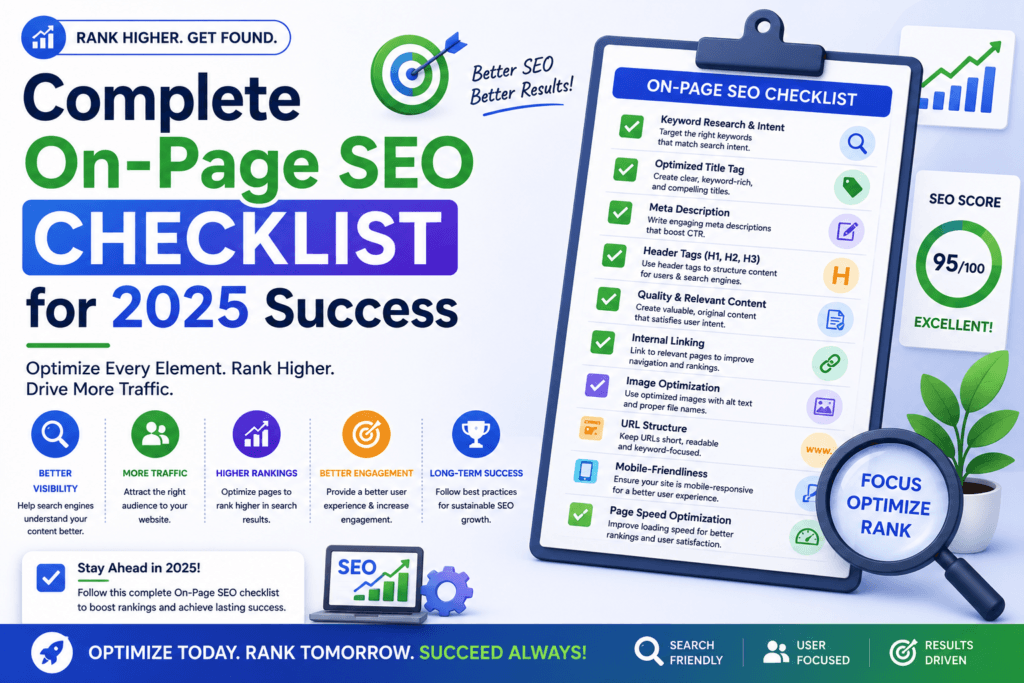
On-page SEO is everything you change on a page to help it rank and help people (and AI tools) understand it. Off-page signals like links still matter, but if the page itself is unclear, slow, or thin, those links won’t save it.
Use this checklist to improve organic rankings and AEO (answer engine optimization) without stuffing keywords or publishing filler.
What is on-page SEO?
On-page SEO covers:
- Content quality and structure
- Titles, meta descriptions, and headings
- URL clarity
- Internal links
- Images and accessibility
- Page experience (mobile, speed, Core Web Vitals)
- Schema and FAQ formatting
In short: make each page useful, clear, and easy to crawl.
Why it still matters in 2026
Search engines and AI answer engines both lean on clean, helpful pages. A strong on-page setup helps you:
- Match search intent
- Earn clicks from classic results
- Get cited in AI Overviews, ChatGPT, or Perplexity more often
- Convert visitors once they land
For the wider trend context, see SEO trends for 2026.
A. Before you write
1. Pick one primary intent
Decide if the page should inform, compare, or convert. One page, one job.
2. Choose one primary keyword idea
Add a few close variants. For local pages, prefer specific phrases — see long-tail keywords for local businesses.
3. Check competitors lightly
Look at what already ranks and what questions they miss. A quick SEO competitor analysis is enough to start.
4. Avoid cannibalization
Don’t publish two pages fighting for the same query. Map keywords in a simple sheet: URL → primary topic → intent.
B. Page essentials
5. SEO-friendly URL
- Short and readable
- Hyphens, not underscores
- No messy parameters when you can avoid them
- Example:
/on-page-seo-checklist/
6. Title tag
- Aim for about 60 characters
- Put the main idea near the front
- Make it worth clicking
- Keep each title unique
7. Meta description
- Unique per page
- Roughly 150–160 characters
- Plain benefit + soft CTA
- No keyword stuffing
8. Headings
- One H1 that matches the page topic
- H2/H3 for scannable sections
- Use question-style headings where people actually ask questions
C. Content quality
9. Answer first
Open with a short, direct answer in 2–4 sentences. This helps readers and AEO.
10. Be useful, not just long
Cover the what / why / how. Add examples. Skip padded intros.
11. Show E-E-A-T
Real author name, honest bio, sourced facts, updated dates when needed.
12. Place keywords naturally
Title, H1, intro, and a few body mentions are enough. If it sounds forced, rewrite.
13. Refresh old pages
Update outdated years, screenshots, and advice instead of only publishing new posts.
D. Links and media
14. Internal links
- Link to related guides with clear anchors
- Avoid “click here”
- Make sure important pages aren’t buried
Useful related posts on this site include AI answer engines, local SEO benefits, and search engine positioning.
15. Outbound links
Link to trustworthy sources for claims. Open external links in a new tab if that fits your UX. Don’t hand over your money keywords to a competitor for free.
16. Images
- Compress before upload
- Descriptive file names
- Useful alt text
- Prefer modern formats like WebP when possible
E. Technical and page experience
17. Mobile-first
The page must work well on a phone: readable text, easy taps, no horizontal scroll.
18. Core Web Vitals
Check in PageSpeed Insights / Lighthouse:
- LCP — main content loads quickly
- INP — page responds fast to clicks/taps
- CLS — layout doesn’t jump around
(FID is outdated; use INP.)
19. HTTPS and accessibility
- Valid SSL / HTTPS
- Logical heading order
- Alt text and readable forms
- Enough color contrast
20. Schema (when it matches the page)
Add JSON-LD only for what users can see: Article, FAQ, Product, LocalBusiness, etc. Fake schema hurts more than it helps.
21. Indexation basics
- XML sitemap submitted in Search Console
- No accidental
noindexon money pages - Canonical tags for duplicates
- Clean
robots.txt
For deeper crawl/index issues, use common technical SEO mistakes. New sites can start here: SEO for a new website.
F. AEO extras (for citations, not tricks)
22. FAQ block
Add 3–6 real questions with short answers under the questions.
23. Quotable facts
Put definitions, steps, and comparisons in clean paragraphs or tables.
24. Clear identity
Brand and author names consistent across the site.
More on citations: how to get cited by AI answer engines.
G. Measure and maintain
25. Track the basics
- Google Search Console
- GA4
- Rankings for primary queries
- Conversions (forms, calls, sales)
- AI referrals when they appear (for example chatgpt.com)
Off-page still supports on-page work — earn high-quality backlinks rather than buying junk.
One-page summary checklist
- One intent + one primary topic
- Clean URL
- Unique title (~60) + meta
- One clear H1 + logical H2/H3s
- Answer-first intro
- Helpful content + author/trust signals
- Natural keywords (no stuffing)
- Internal + a few trusted outbound links
- Compressed images + alt text
- Mobile-friendly
- Solid LCP / INP / CLS
- HTTPS + accessibility basics
- Relevant schema only
- Indexable + canonicals where needed
- FAQ for AEO
- Tracking in GSC + GA4
- Scheduled content refresh
Frequently asked questions
Is on-page SEO enough by itself?
It’s the foundation. You still need crawlability, and for competitive terms you’ll usually need links and brand signals too.
How often should I update a page?
When facts change, or at least review top pages a few times a year.
Do I need schema for every page?
No. Use it when it matches visible content.
Does on-page SEO help with ChatGPT or Perplexity?
Yes, indirectly. Clear answers, structure, and trust make citation more likely.
Final thoughts
Treat this as a working list, not a one-time audit. Fix the page essentials first, then content depth, then speed and AEO formatting. Small, steady improvements beat a giant rewrite you never maintain.
About the author
Saurabh K. has been working in SEO and digital marketing for 10+ years, helping businesses grow their search traffic.