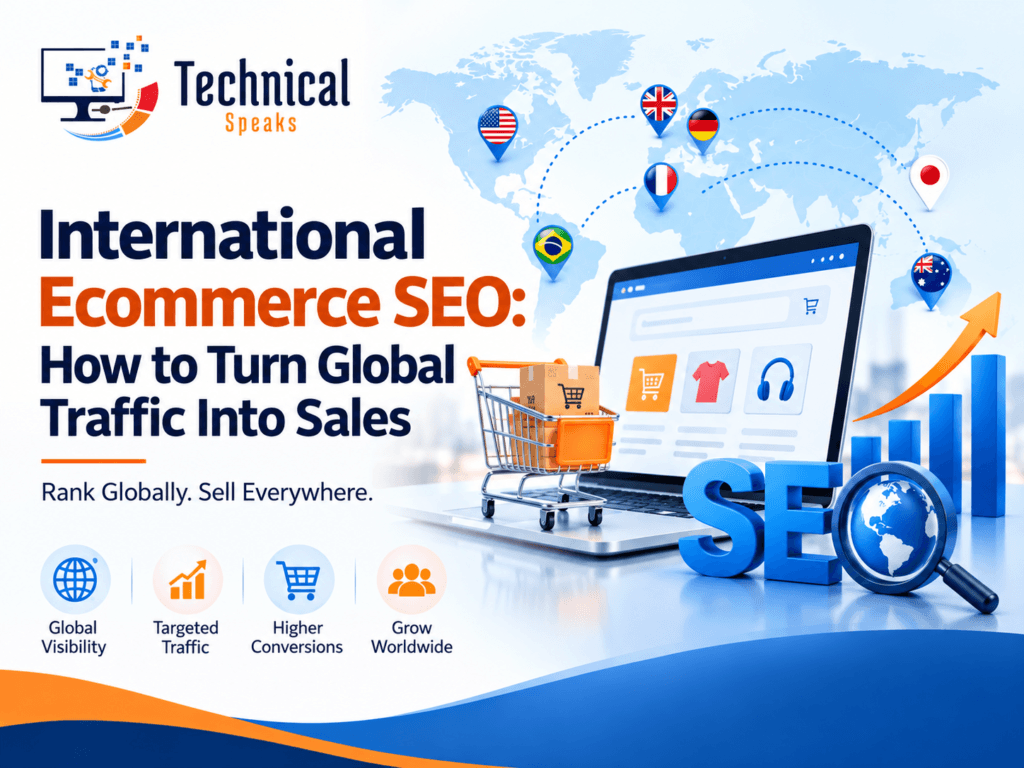
International ecommerce SEO is the practice of optimizing your online store to rank in search results across multiple countries and languages, ensuring that global shoppers find the right version of your site at the right time. By applying effective e-commerce SEO strategies, businesses can improve visibility across different markets and connect with shoppers based on their location, language, and search intent. Most ecommerce brands treat international expansion as a pricing and checkout problem—set up local currencies, configure shipping zones, done. But the traffic that actually converts doesn’t come from checkout. It comes from search engines that understand which regional version of your store belongs in front of which searcher. Get that wrong, and your new storefronts sit in a kind of search limbo: indexed, but never surfaced.
This guide breaks down the technical signals, content strategies, and pricing realities that separate brands that launch internationally from brands that actually sell internationally.
The Technical Foundation: Making Search Engines Understand Your Global Store
Before content or keywords, you need search engines to correctly identify which regional version of each page should rank for which audience. This is where most international ecommerce SEO strategies fail.
Hreflang Tags: The Signal, Not the Fix
Hreflang tags tell search engines that two pages are equivalent content for different languages or regions. They don’t create rankings—they redirect existing rankings to the correct regional audience.
The most common failure mode on platforms like Shopify: non-reciprocal tagging. If your US page links to your UK page but the UK page doesn’t link back, most engines disregard the pair entirely. This error is invisible unless someone audits both directions.
URL Structure: ccTLD vs. Subdomain vs. Subdirectory
Three options dominate, each with distinct tradeoffs:
| Structure | Example | Best For | Maintenance Load |
|---|---|---|---|
| ccTLD | store.de | Strong local trust signals | High—separate sites per country |
| Subdomain | de.store.com | Balanced control and cost | Medium |
| Subdirectory | store.com/de | Simplest management | Low—single site |
Google’s John Mueller has stated that search can handle subdomains or subdirectories equally well—the choice should depend on your long-term operational plans, not SEO mythology.
The critical insight most brands miss: International SEO is not international checkout. Checkout solves how you charge foreign customers. SEO solves whether they find you in the first place.
Localization Beyond Translation: Why “Sweater” Isn’t Just a Word
Translation converts words. Localization converts intent. A “sweater” in New York is a “jumper” in London. Units need to shift from inches to centimeters. Prices need to display in local currency—not just converted, but psychologically rounded (€19.99, not €18.47).
72% of consumers spend more time on websites in their native language, and 56% say getting information in their own language matters more than price. This isn’t a nice-to-have. For non-English markets, it’s a conversion requirement.
The practical hierarchy for localization investment:
High-traffic pages first: Product detail pages, category pages, checkout flow
Legal and trust content second: Return policies, shipping terms, privacy
Everything else third: Blog posts, about pages
Start with machine translation for lower-traffic pages, then upgrade to human translation as a market proves itself. The brands that succeed don’t localize everything at once—they localize strategically and expand as revenue justifies.
International Ecommerce SEO Pricing: What to Actually Budget
Pricing for international ecommerce SEO varies wildly because scope varies wildly. A single-store operation adding hreflang to 50 products looks nothing like a 10,000-SKU catalog across 12 markets.
Typical Ranges (2025–2026)
| Service Level | Monthly Retainer | What It Covers |
|---|---|---|
| Entry / SMB | $1,000–$3,000 | Single market, technical fixes, on-page optimization |
| Mid-Market | $3,000–$8,000 | Multi-region setup, content localization, hreflang management |
| Enterprise / Multi-Market | $8,000–$25,000+ | Full international architecture, content production at scale, link acquisition |
The biggest pricing trap: Most retainers exclude the very services that international SEO techniques depend on. Technical audits, content production, hreflang implementation, and international link acquisition are frequently quoted separately. A $2,500/month retainer that doesn’t include content production or technical implementation is more expensive than a $5,000/month retainer that does.
Ask every agency: “What work completes every month, and what gets quoted on top?”
5 Best SEO Service Providers in India for 2025–2026
India has become a global hub for SEO talent, particularly for ecommerce brands seeking cost-effective international optimization. Here are five providers with demonstrated capability in cross-border ecommerce SEO.
1. TechnicalSpeaks
Key Strength: Real-time execution with a focus on technical SEO foundations for international storefronts.
Ideal Client: Ecommerce brands that need hands-on hreflang implementation, site architecture fixes, and Shopify/WooCommerce technical optimization without agency bloat. TechnicalSpeaks works with clients who value direct communication and measurable technical deliverables over polished reporting decks.
2. Techmagnate
Key Strength: Large-scale AI SEO and LLM optimization for enterprise brands, with 200+ specialists and nearly two decades of organic growth experience.
Ideal Client: BFSI, SaaS, healthcare, and ecommerce enterprises requiring integration with AI-driven search platforms like ChatGPT, Gemini, and Google SGE. Clients have experienced significant organic traffic growth with visibility extending beyond traditional SERPs.
3. RankSnack
Key Strength: Personalized campaigns tailored to niche markets, with a focus on white-hat link building and long-term organic presence.
Ideal Client: Small and medium ecommerce businesses seeking customized keyword research, content mapping, and link acquisition without enterprise-scale pricing. Better suited for brands wanting close client relationships and tactical execution.
4. ARM Worldwide
Key Strength: Full-suite digital marketing integration, combining AI SEO with web development and multi-channel campaign management.
Ideal Client: B2B and B2C ecommerce brands needing end-to-end solutions from SEO audit through website development. Strong creative and technical balance, though SEO may be less specialized than niche-focused agencies.
5. OLBUZ
Key Strength: Deep focus on Core Web Vitals, site speed, and technical performance for multi-location visibility.
Ideal Client: Ecommerce stores struggling with page experience signals or requiring local SEO planning across multiple markets. Particularly strong for brands where technical performance directly impacts conversion rates.

How to Find the Right SEO Professionals for Your Business
The wrong SEO partner wastes budget and time. The right one becomes a revenue multiplier. Here’s a practical framework for evaluation.
The Three Questions That Expose Everything
Ask every prospective agency or consultant these questions during the sales process:
What work will you complete every month? (Not what reports, not what “strategy”—what actual deliverables?)
What’s handled in-house, and what’s outsourced? (Outsourcing isn’t inherently bad, but you deserve to know.)
How will you measure SEO success beyond keyword rankings? (If the answer is only “rankings” or “traffic,” walk away. You need revenue attribution.)
Match Expertise to Your Platform
Shopify, WooCommerce, Magento, and custom builds have different technical constraints. A Shopify SEO specialist who understands Markets, hreflang automation, and app ecosystem limitations will outperform a generalist every time. Ask for platform-specific case studies—not just “ecommerce clients.”
Beware of the “Audit-Only” Trap
Some agencies deliver beautiful SEO audit reports with 200-page slide decks but never implement anything. For international ecommerce SEO, the work is in the doing: implementing hreflang, restructuring URLs, localizing content, fixing crawl errors across regional storefronts. Prioritize agencies with implementation capability, not just diagnostic skills.
The Budget-to-Value Test
Compare proposals by execution, not by retainer size. A $1,500/month agency that only delivers audits costs more than a $4,000/month agency that improves rankings, qualified traffic, and revenue. The question isn’t “what’s the lowest monthly fee?” It’s “what revenue growth justifies this investment?”
FAQs
What is international ecommerce SEO?
International ecommerce SEO is the process of optimizing an online store to rank in search results across multiple countries, languages, and regions. It involves technical elements like hreflang tags and regional URL structures, plus content localization and market-specific keyword research.
How much does international ecommerce SEO cost in 2025–2026?
Monthly retainers typically range from $1,000–$3,000 for single-market SMBs, $3,000–$8,000 for multi-region mid-market brands, and $8,000–$25,000+ for enterprise catalogs. Most retainers exclude content production, technical implementation, and link acquisition—budget for these separately.
Do I need separate websites for each country?
Not necessarily. Subdirectories (store.com/de) and subdomains (de.store.com) both work for international SEO when configured correctly. ccTLDs (store.de) offer stronger local trust signals but require separate site management. Choose based on operational capacity, not SEO myths.
How long does international ecommerce SEO take to show results?
Technical fixes like hreflang can show impact in 4–8 weeks. Content localization and authority building typically take 3–6 months per market before meaningful organic revenue. Rolling out one market at a time is more effective than launching five poorly-configured regions simultaneously.
Can I use machine translation for my international store?
Yes, as a first layer. Use AI or machine translation for lower-traffic pages, then upgrade high-value pages (product details, checkout, legal content) to human translation as a market proves revenue potential. This staged approach balances speed and quality.