
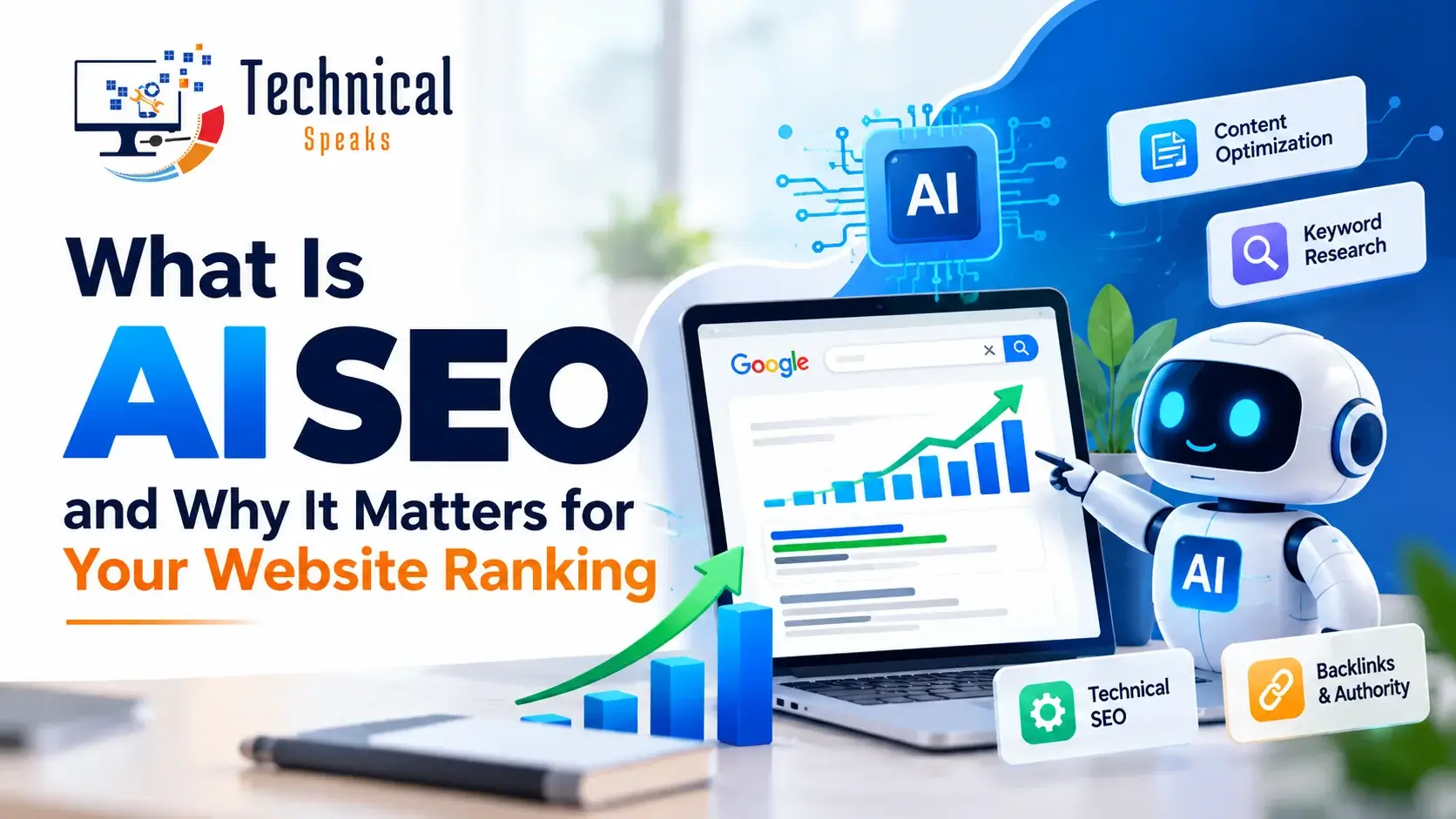
AI SEO has two meanings. The first is using AI tools to do SEO work faster: keyword research, clustering, content briefs, audits. The second is optimizing your website so it shows up in AI-powered search, such as Google’s AI Overviews, ChatGPT, Perplexity and Copilot. In 2026 you need both. AI helps you work faster, and AI search is where a growing share of people find answers.
Here’s what each side involves, what still works from classic SEO, and a simple workflow you can start with.
AI SEO: the two meanings at a glance
| Using AI for SEO | Optimizing for AI search | |
|---|---|---|
| What it is | AI tools that help with SEO tasks | Making your content easy for AI systems to find, understand and cite |
| Goal | Save time, find insights faster | Appear in AI answers and citations |
| Examples | Keyword clustering, content briefs, audits, meta drafts | Answer-first content, clear structure, schema, trusted sources |
| Main risk | Generic or inaccurate content | Being invisible when AI answers the question for the user |
Part 1: Using AI to do SEO
AI is very good at the repetitive, data-heavy parts of SEO. It’s weaker at judgment, originality and knowing what’s true. Use it like a fast assistant, not an autopilot.
Where AI genuinely helps
- Keyword research and clustering: grouping hundreds of keywords by topic and intent in minutes. Pair it with real search data from your tools.
- Content briefs and outlines: suggesting subtopics, questions to answer and competitor gaps.
- Drafting and editing: first drafts of meta descriptions, FAQs and alt text, or tightening your writing.
- Technical work: writing regex, schema markup, redirect lists or spreadsheet formulas, and explaining crawl errors.
- Analysis: summarizing Search Console exports, spotting pages that are losing clicks, comparing competitors.
What to keep human
- Strategy and priorities
- First-hand experience, opinions and real examples
- Fact-checking every number, quote and claim
- Final editing for tone, accuracy and brand voice
Does Google penalize AI-generated content?
Not for being AI-written. Google’s guidance says it rewards helpful, original content however it’s made. But mass-producing pages mainly to manipulate rankings breaks its spam policies, whether a human or a machine writes them. The safe rule: AI can help you write, but every page must be accurate, useful and genuinely better than what’s already out there.
Part 2: Optimizing for AI search
AI search tools don’t just list links. They read sources and write an answer, often with citations. Your goal shifts from “rank #1” to “be one of the sources the answer is built from.“
Where AI answers appear
- Google AI Overviews and AI Mode: AI summaries at the top of, or alongside, Google results
- ChatGPT search
- Perplexity
- Microsoft Copilot
- Gemini
This is also called AEO (answer engine optimization) or GEO (generative engine optimization). The names differ, but the work is largely the same. For the deep dive, read our guide to getting cited by AI answer engines.
How to make your content AI-friendly
- Lead with the answer. Start each section with a direct one or two sentence answer, then explain. That’s what gets quoted, and it’s the same skill that wins featured snippets.
- Use question-based headings. Match how people actually ask. Long-tail, conversational keywords fit naturally here.
- Keep sections self-contained. Each one should make sense if it’s pulled out on its own.
- Be specific and sourced. Give real numbers with links to the original source, real examples and clear definitions.
- Show experience and expertise. Named authors, short bios, first-hand screenshots and case studies.
- Use structure. Clean H2/H3 headings, lists, tables and relevant schema (Article, FAQ, Product, LocalBusiness).
- Let AI crawlers in. Check robots.txt and your firewall don’t block bots like Googlebot, Bingbot, OAI-SearchBot and PerplexityBot. Our Perplexity optimization guide shows how.
- Keep content fresh. Update facts, dates and screenshots on topics that change.
- Build authority. Quality backlinks, brand mentions and topic clusters still matter. AI tools tend to cite sources that are already trusted.
What hasn’t changed
AI search is built on top of the same foundations:
- Pages still need to be crawlable, indexable and fast.
- Helpful, accurate, original content still wins.
- Links and reputation still signal trust.
- Matching search intent still matters more than repeating keywords.
Google has used AI in ranking for years, through systems like RankBrain and BERT that help it understand language and intent. Our guide to Google algorithms explains the main systems. So “AI SEO” isn’t a replacement for SEO. It’s SEO adapted to how people search now. For more on that debate, see Is organic SEO dead in the age of AI?
Traditional SEO vs. AI SEO
| Traditional SEO | AI SEO (2026) | |
|---|---|---|
| Main goal | Rank in the blue links | Rank and be cited in AI answers |
| Keyword research | Manual lists and spreadsheets | AI-assisted clustering by topic and intent |
| Content | Long pages targeting a keyword | Answer-first, well-structured, self-contained sections |
| Success measure | Rankings, clicks | Rankings, clicks, AI citations and brand mentions |
| Workflow | Mostly manual | Human strategy plus AI for repetitive tasks |
A simple AI SEO workflow
- Research: pull keywords and questions from Search Console and your SEO tool, then use AI to cluster them by intent. A competitor analysis shows who’s winning those topics.
- Plan: choose one main question per page and build a topic cluster with internal links.
- Brief: have AI draft an outline and a list of questions, then add your own angle and experience.
- Write: draft with or without AI, but add real examples, sourced facts and your opinion, then edit for a natural tone.
- Optimize: run through an on-page SEO checklist, add schema and internal links.
- Check AI visibility: search your target questions in Google, ChatGPT and Perplexity, and note who gets cited.
- Measure and update: track Search Console clicks, AI referral traffic in GA4 (sources like chatgpt.com and perplexity.ai) and citations, then refresh pages that slip.
AI SEO tools by job
| Job | Example tools |
|---|---|
| Research and clustering | Semrush, Ahrefs, Google Search Console + an AI assistant |
| Content optimization | Surfer SEO, Clearscope, Frase, MarketMuse |
| Writing help | ChatGPT, Gemini, Claude (always edit and fact-check) |
| Technical SEO | Screaming Frog (with AI features), PageSpeed Insights |
| Tracking AI visibility | Manual checks, GA4 referrals, AI-visibility features in major SEO suites |
Starting on a budget? Our list of free SEO tools covers the essentials.
Common AI SEO mistakes
- Publishing AI drafts without fact-checking. Made-up stats and sources are common.
- Mass-producing thin pages on every keyword variation
- Content that sounds like everyone else’s, with no experience or opinion
- Blocking AI crawlers by accident through robots.txt or a firewall
- Chasing AI citations while ignoring the technical basics
- Expecting tools to replace strategy
FAQ
What is AI SEO in simple words?
It means using AI tools to do SEO work faster, and optimizing your website so AI-powered search tools like Google AI Overviews, ChatGPT and Perplexity can find and cite it.
Is AI SEO suitable for small businesses?
Yes. AI tools save time on research and writing, and small businesses with clear, expert, local content can be cited in AI answers just like big brands.
Does AI SEO replace human SEO experts?
No. AI speeds up repetitive tasks, but strategy, fact-checking, original insight and judgment still need people.
Will AI-generated content hurt my SEO?
Not by itself. Google judges content by how helpful and original it is. Low-quality, mass-produced content can hurt you no matter who or what wrote it.
What’s the difference between AI SEO, AEO and GEO?
AI SEO is the umbrella term. AEO (answer engine optimization) and GEO (generative engine optimization) both describe optimizing content to appear in AI-generated answers.
How do I know if AI search is sending me traffic?
Check GA4 referral sources such as chatgpt.com, perplexity.ai and copilot.microsoft.com, and regularly search your key questions in AI tools to see whether you’re cited.
Final thoughts
AI SEO isn’t a trick or a replacement for SEO. It’s two practical shifts: using AI to work faster, and writing content that AI search can understand, trust and cite. Keep the human parts human, like strategy, experience and accuracy, let AI handle the repetitive work, and build pages that give the clearest answer on the web. That’s how you rank in classic search and show up in AI answers too.
Want help making your site visible in AI search? Get in touch with our team today.
Saurabh K. has been working in SEO and digital marketing for 10+ years, helping businesses grow their search traffic.


Comments
Leave a comment