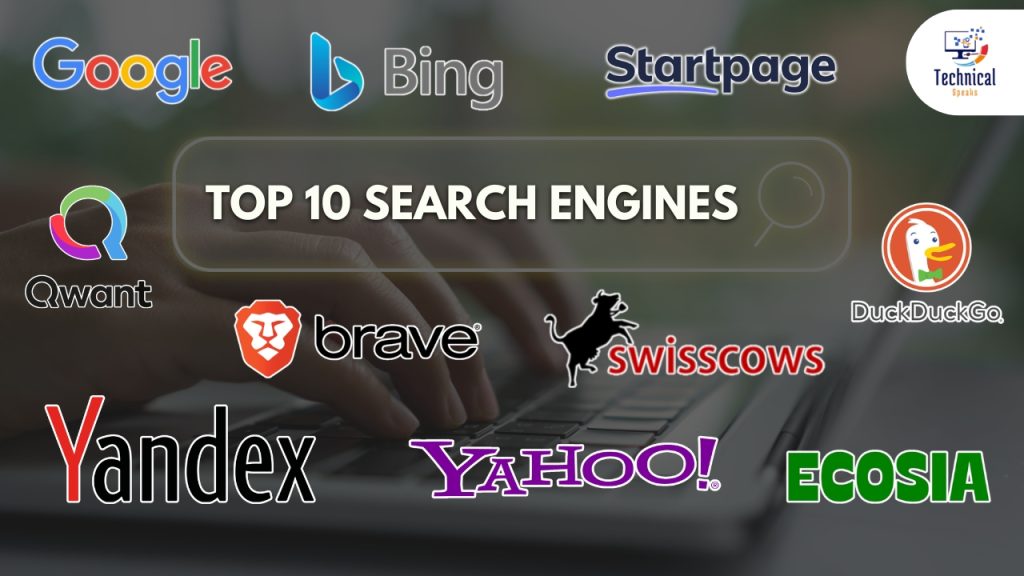
1. Google – The Global Search Leader
Overview
When it comes to online searches, Google stands as the world’s most dominant and trusted search engine. If you’re wondering how to rank #1 on Google, understanding how Google’s powerful indexing system works is the first step. It ensures users receive highly relevant results within milliseconds. Google’s seamless integration with services like Google Maps, Google Images, and Google News creates an all-in-one platform that caters to virtually every search need while rewarding websites that deliver valuable, high-quality content.
Key Features
Unmatched search accuracy and lightning-fast speed
Personalized results based on browsing history and preferences
Deep integration with Google Maps, Google Images, and Google News
AI-powered voice search and Google Assistant compatibility
Optimized experience across mobile devices and desktop computers
Best For
Users who need fast, accurate, and relevant search results with a user-friendly interface. However, if privacy is your top concern, consider exploring other options.
2. Bing – Microsoft’s Smart Search Alternative
Overview
Microsoft’s Bing has emerged as Google’s strongest competitor, serving as the default search engine for Windows systems. With deep integration across Edge browser and Windows 11, Bing offers a rewarding search experience through its Bing Rewards program, where users earn points for searches and redeem them for gift cards.
Key Features
Native integration with Windows 11 and Microsoft Edge
Bing Rewards program for earning points and gift cards
Superior image and video search quality
AI-driven chatbot via Microsoft Copilot
Enhanced results for technical queries and product searches
Best For
Windows users seeking a smooth, integrated search experience with bonus rewards for everyday searches.
3. DuckDuckGo – The Privacy-First Search Engine
Overview
When exploring the top SEO blogs, DuckDuckGo stands out for its strong commitment to user privacy. Unlike many search platforms, it never tracks or stores personal data, allowing users to search anonymously. Its Instant Answers feature gathers information from more than 400 trusted sources, providing quick, reliable answers while maintaining complete privacy.
Key Features
Zero tracking or personalized advertising
Instant answers powered by 400+ sources
Tor integration for anonymous browsing
Unbiased results without filter bubbles
Best For
Privacy-conscious users who want accurate information without being tracked or profiled.
4. Yahoo! Search – A Trusted Industry Veteran
Overview
Powered by Microsoft Bing’s technology, Yahoo! Search remains a relevant alternative with unique advantages. Its deep integration with Yahoo’s ecosystem—including Yahoo Mail, Yahoo Finance, and Yahoo News—makes it particularly attractive for existing Yahoo users.
Key Features
Seamless integration with Yahoo Mail, News, and Finance
Rich multimedia search results
Excellent coverage of trending topics and news queries
Best For
Yahoo ecosystem users who value integrated access to their favorite services through the search experience.
5. Brave Search – Built for Security and Speed
Overview
International SEO keyword research helps businesses identify the right search terms for audiences across different countries and languages. Developed by the team behind the Brave Browser, Brave Search is an independent search engine that prioritizes user privacy, safety, and an ad-free browsing experience. Using its own proprietary search index instead of relying on third-party data, it delivers faster page loads, relevant search results, and a clean, clutter-free interface, making it a valuable platform to consider when planning your international SEO strategy.
Key Features
No tracking, cookies, or personalized advertisements
Faster page loading without third-party tracking scripts
Community-driven ranking algorithms
Independent search index for true search autonomy
Best For
Users seeking a fast, private, ad-free search experience without compromise.
6. Ecosia – Search That Plants Trees
Overview
Ecosia transforms everyday searches into environmental action, donating up to 80% of its ad revenue to tree-planting projects worldwide. Powered by Bing’s search technology, Ecosia also protects user privacy with no permanent personal data storage.
Key Features
Bing-powered search with enhanced privacy protections
Every search contributes to global reforestation
Carbon-neutral operations
Transparent financial reporting on tree-planting initiatives
Best For
Environmentally conscious users who want their online activity to make a tangible difference.
7. Yandex – The Leading Search Engine for Russia
Overview
A complete On-Page SEO checklist helps ensure your content is optimized for different search engines, including Yandex. Yandex dominates the Russian and Eastern European search market and is especially effective at indexing Russian-language content. Beyond search, Yandex offers a comprehensive suite of services similar to Google, including cloud storage, AI-powered voice assistants, email, and other digital tools. If your website targets Russian-speaking audiences, optimizing it with an effective On-Page SEO Checklist can improve your visibility and search rankings on Yandex.
Key Features
Superior search results for Russian-language content
AI-driven voice assistant integration
Free cloud storage for Yandex account holders
Comprehensive ecosystem of web services
Best For
Users who frequently access Russian or Eastern European content and need region-specific search accuracy.
8. Startpage – Google Results Without the Tracking
Overview
Startpage acts as a privacy shield, delivering Google’s high-quality search results without the tracking. Acting as an intermediary, Startpage ensures complete anonymity while offering optional proxy browsing to hide IP addresses.
Key Features
Google’s search index without tracking or profiling
Proxy browsing for added IP address protection
No personalized search results
Anonymous search experience
Best For
Users who want Google’s precision but refuse to compromise on privacy.
9. Swisscows – AI-Powered Family-Friendly Search
Overview
Based in Switzerland, Swisscows combines advanced AI with strict privacy standards. The platform automatically discards user data and filters violent or adult content by default, making it an excellent choice for families. If you’re searching for low-competition SEO keywords related to private search engines, Swisscows is a valuable option to include in your content because of its strong focus on security and family-friendly browsing.
Key Features
No data storage or tracking
AI-powered semantic search suggestions
Automatic blocking of violent and adult content
Swiss-based privacy protection
Best For
Families and users seeking a safe, privacy-focused search environment for children.
10. Qwant – Europe’s Privacy-First Search Engine
Overview
Qwant, a French search engine, maintains strict adherence to EU privacy regulations. The platform never collects user data or personalizes results based on tracking, offering fair and unbiased search outcomes while complying with Europe’s stringent privacy laws.
Key Features
No advertisements or tracking
Unbiased, fair search results
Full compliance with EU privacy regulations
European-based data protection
Best For
European users and anyone looking for a privacy-focused search engine that complies with GDPR standards often prefer platforms that prioritize data protection. While privacy is essential, building quality backlinks from trusted and relevant websites can also improve your search engine rankings and help your content reach a wider audience across privacy-conscious search engines.
Comparison Summary Table
| Search Engine | Best For | Privacy Rating | Unique Advantage |
|---|---|---|---|
| General use | ★☆☆☆☆ | Unmatched accuracy & integration | |
| Bing | Windows users | ★★☆☆☆ | Rewards program & Copilot AI |
| DuckDuckGo | Privacy | ★★★★★ | Zero tracking |
| Yahoo! | Yahoo ecosystem | ★★☆☆☆ | Service integration |
| Brave Search | Speed & privacy | ★★★★★ | Independent search index |
| Ecosia | Environmental action | ★★★★☆ | Plants trees with every search |
| Yandex | Russian content | ★★☆☆☆ | Superior Cyrillic search |
| Startpage | Google + privacy | ★★★★★ | Google results without tracking |
| Swisscows | Family safety | ★★★★★ | AI-powered, content-filtered |
| Qwant | EU privacy compliance | ★★★★★ | GDPR-compliant neutrality |
Frequently Asked Questions (FAQs)
General FAQs
Q1: Which search engine is the best overall?
Google remains the best overall search engine for most users due to its superior indexing, speed, accuracy, and integration with services like Maps, Images, and News. However, “best” depends on your priorities—whether it’s accuracy, privacy, rewards, or environmental impact.
Q2: Are alternative search engines as accurate as Google?
When comparing search engines, most alternatives provide comparable accuracy. Bing and Yahoo! use similar search technologies, while DuckDuckGo and Startpage deliver Google search results without tracking users. While Google still has an advantage with its proprietary algorithms for handling complex, ambiguous, or highly specific queries, using the Best Free SEO Tools can help you analyze search performance, compare search engine visibility, and optimize your website for better rankings across multiple platforms.
Q3: How do search engines make money?
Search engines primarily generate revenue through:
Pay-per-click (PPC) advertising – Advertisers pay when users click their ads
Sponsored search results – Brands pay for prominent placement
Display advertising – Banner and video ads shown alongside results
Data analytics – Aggregated user data (though privacy-focused engines avoid this)
Q4: Can I use multiple search engines simultaneously?
Absolutely! You can:
Set different default search engines in different browsers
Use browser extensions that allow quick switching between search engines
Bookmark multiple search engines for specific use cases (e.g., Ecosia for eco-searches, DuckDuckGo for private searches)
Privacy & Security FAQs
Q5: Which search engine is the most private?
DuckDuckGo, Brave Search, Startpage, Swisscows, and Qwant are considered the most private options. These engines:
Do not store your IP address or search history
Do not create user profiles
Do not personalize results based on past activity
Offer additional features like Tor integration or proxy browsing
Q6: Is Google tracking my searches even in Incognito mode?
Yes. Incognito mode only prevents your browser from saving your browsing history locally. Google can still track your searches, associate them with your IP address, and use that data for ad targeting unless you’re using a VPN or a privacy-focused search engine. This is why understanding how local search works and choosing privacy-friendly tools can help you protect your online activity while finding relevant local information.
Q7: Does using a private search engine make me completely anonymous?
While private search engines significantly enhance privacy, complete anonymity requires additional measures:
Using a VPN to hide your IP address
Browsing via Tor browser
Using multiple layers of privacy protection
Avoiding logging into any accounts during searches
Technical & Usage FAQs
Q8: Can I switch my default search engine on my browser?
Yes, here’s how:
| Browser | Steps |
|---|---|
| Chrome | Settings → Search Engine → Manage Search Engines → Select Default |
| Firefox | Options → Search → Default Search Engine → Select from dropdown |
| Edge | Settings → Privacy, Search, and Services → Address Bar and Search |
| Safari | Preferences → Search → Search Engine → Select from options |
| Brave | Settings → Search Engine → Select default from dropdown |
Q9: Do search engines work differently on mobile vs. desktop?
Most search engines offer optimized experiences for both platforms:
Mobile versions often prioritize local results, voice search, and app integration
Desktop versions typically display more comprehensive results with additional features
However, core search algorithms remain consistent across platforms.
Q10: What is the difference between a search engine and a browser?
| Feature | Search Engine | Browser |
|---|---|---|
| Purpose | Finds information online | Displays web pages and content |
| Examples | Google, Bing, DuckDuckGo | Chrome, Firefox, Safari |
| Function | Processes queries and returns results | Renders HTML, CSS, JavaScript |
| Dependency | Can be accessed via any browser | Requires internet to access search engines |
Q11: How do search engines rank results?
Search engines use complex algorithms that consider hundreds of factors, including:
Relevance – How well content matches the query
Authority – Number and quality of backlinks
Freshness – Timeliness of content
User engagement – Click-through rates, bounce rates, dwell time
Technical SEO – Page speed, mobile-friendliness, secure connections
Context – Location, device, search history (for non-private engines)
Niche & Specialized FAQs
Q12: Is Ecosia really effective at planting trees?
To improve website content for SEO, it’s important to use reliable and trustworthy platforms as examples. Ecosia has planted over 180 million trees worldwide and publishes monthly financial reports, demonstrating its commitment to transparency. The search engine donates 80% of its surplus profits to reforestation projects across 35+ countries, making it an excellent example of how valuable, trustworthy content can strengthen user confidence.
Q13: What makes Bing Rewards worth using?
Bing Rewards (now called Microsoft Rewards) offers:
Points for daily searches
Bonus points for using Microsoft Edge and Bing Mobile
Redeemable gift cards (Amazon, Starbucks, Xbox, etc.)
Entry into sweepstakes and giveaways
Points don’t expire as long as you remain active
Q14: How does Brave Search maintain an independent index?
Brave Search:
Uses its own search index rather than licensing from Google or Bing
Incorporates community feedback for ranking improvements
Uses anonymous data to improve results without compromising privacy
Continuously crawls and indexes the web independently
Q15: Can I use Qwant outside of Europe?
Yes, Qwant is available globally. While it’s particularly popular in Europe due to GDPR compliance, users worldwide can access its privacy-focused search features without regional restrictions.
SEO & Business FAQs
Q16: Does using a private search engine affect SEO?
No, using a private search engine doesn’t affect your website’s SEO. However, it does mean:
You won’t see personalized search results
Your clicks and browsing won’t influence future rankings
You’ll see “unbiased” results that may differ from personalized ones
SEO Tip: Optimize for all major search engines by following best practices, not just Google.
Q17: Should businesses advertise on alternative search engines?
Yes, diversifying ad spend across multiple platforms offers advantages:
Lower CPC on Bing and Yahoo! compared to Google
Less competition for certain keywords
Access to different demographics (e.g., older users on Yahoo!)
Privacy-focused users on DuckDuckGo who avoid traditional ads
Environmental branding opportunities on Ecosia
Q18: How do I optimize for multiple search engines?
To rank well across various search engines:
Focus on high-quality content that provides real value
Build authoritative backlinks from reputable sources
Ensure technical SEO fundamentals (speed, mobile-friendliness)
Use schema markup for rich snippets
Monitor keyword performance across platforms
Avoid black-hat SEO tactics that may work on one engine but penalize on another
Final FAQs
Q19: Will AI replace traditional search engines?
AI is transforming search through:
Conversational search (like ChatGPT search)
Summarized answers instead of just links
Multimodal search (text, image, voice combined)
However, traditional search engines are evolving by integrating AI rather than replacing it. The future will likely feature hybrid models that combine AI-generated insights with traditional indexed results. At the same time, website owners must continue following best SEO practices to avoid a Google penalty in SEO, as search engines still prioritize high-quality, relevant, and trustworthy content.
Q20: What’s the best search engine for academic research?
| Need | Recommended Engine |
|---|---|
| General academic | Google Scholar |
| Peer-reviewed journals | Microsoft Academic (via Bing) |
| Privacy-focused research | DuckDuckGo or Startpage |
| Multilingual studies | Yandex (for Slavic languages) |
| Open access resources | BASE, CORE (specialized academic engines) |
Final Recommendations
Choose Google if: You prioritize speed, accuracy, and access to integrated services above all else.
Choose DuckDuckGo, Brave Search, or Startpage if: Your primary concern is online privacy and avoiding tracking.
Choose Ecosia if: You want your daily searches to contribute to environmental restoration.
Choose Bing if: You’re a Windows user who values rewards and Microsoft ecosystem integration.
Choose Yandex or Qwant if: You need region-specific content or EU-compliant privacy protection.
Choose Swisscows if: You’re searching for a family-safe environment with AI-powered results,