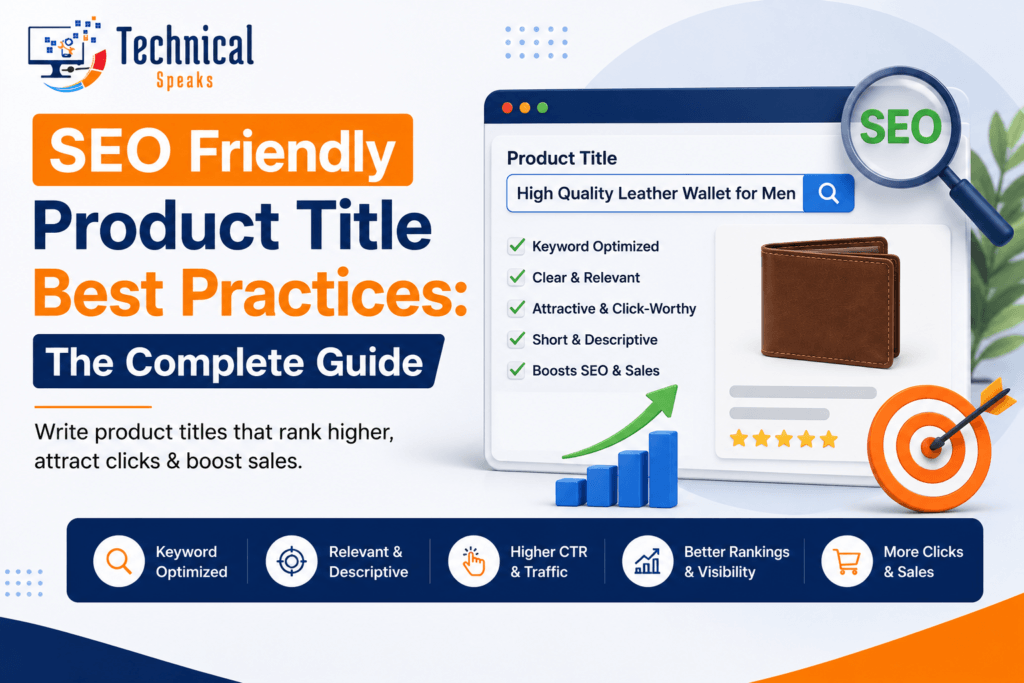
Mastering SEO friendly product title best practices is the single most impactful step you can take to improve your e-commerce visibility. Your product title is the first—and often only—chance to make an impression on both search engines and potential customers. A well-crafted title acts as a powerful headline that drives clicks, improves rankings, and ultimately boosts sales. In the crowded online marketplace, where shoppers spend only seconds scanning results, getting your title right is non-negotiable.
To create an SEO-friendly product title: lead with your primary keyword, include key attributes like brand, size, color, or material, keep it between 50-75 characters, avoid keyword stuffing and promotional language, and use a consistent format across your catalog. Research shows that 51% of shoppers consider product titles and descriptions the most important elements for completing a purchase.
The Anatomy of a Winning Product Title
The Essential Formula
A successful product title follows a proven structure:
Brand + Product Type + Key Feature(s) + Size/Color/Variant
This format provides search engines with clear context about your product while giving shoppers the information they need at a glance. For example: “Sony WH-1000XM5 Wireless Noise Cancelling Headphones” immediately tells shoppers what the product is, who makes it, and what makes it special. The same principle applies to Local SEO for Dentists, where clear, descriptive titles and optimized content help search engines understand your services while making it easier for potential patients to find and trust your dental practice.
Character Limits: Balancing SEO and User Experience
Different platforms have varying requirements. Amazon will soon enforce a 75-character limit for most categories to ensure titles display properly on mobile devices. Walmart recommends 50-60 characters, while Faire suggests 35-60 characters for wholesale buyers.
The general consensus across platforms is to keep titles concise—ideally under 100 characters—to ensure full visibility in search results and accommodate shrinking attention spans.
What to Include (and What to Avoid)
Must-Have Elements
Your title should always include:
Primary keyword: The main search term shoppers use to find your product
Key attributes: Size, color, material, or other distinguishing features
Product type: Clear, specific description of what you’re selling
Common Pitfalls to Avoid
❌ Keyword stuffing: “Professional Google penalty recovery services focus on fixing technical issues, removing spam signals, and complying with search engine guidelines.
❌ Promotional language: “Best Seller,” “Free Shipping,” “On Sale”—these get penalized by search engines and platforms
❌ Special characters: Avoid ™, ®, ©, and symbols like / \ & % = + $ # that can break URLs
❌ Subjective claims: Words like “amazing,” “stylish,” or “best” add no value and waste valuable character space
Advanced Optimization Strategies
The Psychology Behind Effective Titles
Research from JD.com revealed fascinating insights about how product titles influence consumer behavior. Experience attribute keywords (like “comfortable” or “durable”) often have a stronger impact on sales than search attributes (like “size” or “color”), particularly when consumers face high uncertainty about a purchase. Interestingly, the number of keywords in a title showed no clear correlation with sales, suggesting quality trumps quantity. The same principle applies to Organic SEO in the Age of AI, where creating content that emphasizes user value, trust, and relevance is far more effective than simply adding more keywords.
Leveraging Long-Tail Keywords
Long-tail keywords—specific phrases of three or more words—attract high-intent shoppers who know exactly what they want. Will likely convert better than simply water bottle because it matches more specific search queries.
Mobile-First Considerations
With the majority of e-commerce browsing happening on mobile devices, your title must be scannable in a small space. A Technical SEO Audit Service can help identify issues that impact product visibility and search performance, ensuring your listings are optimized for both users and search engines. Amazon’s upcoming 75-character limit reflects this reality—if your title doesn’t display fully, you’re losing potential customers.
Platform-Specific Best Practices
Amazon
Keep under 75 characters (after July 2026)
Lead with brand name, then key product specs, then product type
Use Item Highlights for additional details
Walmart
Aim for 50-60 characters
Use Title Case or Sentence Case
Include primary keyword near the beginning
General E-commerce (PrestaShop, Shopify, etc.)
Meta titles should be unique across your store
Product names should also serve as your H1 heading
Avoid duplicate content by writing unique descriptions
Example Transformations
Before (Bad):
“Premium Stainless Steel Insulated Water Bottle – Keeps Drinks Cold 24 Hours, Hot 12 Hours, BPA-Free”
(92 characters, too long, includes promotional language)
After (Good):
“Premium Stainless Steel Insulated Water Bottle – BPA-Free”
(62 characters, concise, mobile-friendly)
FAQ Section
Q: How long should my product title be?
A: Most platforms recommend 50-75 characters, with Amazon enforcing a 75-character limit starting July 2026.
Q: Should I use my brand name in every title?
A: Yes—brand names help with recognition and trust, especially for established brands.
Q: How many keywords should I include?
A: Quality over quantity. Research shows the number of keywords doesn’t directly correlate with sales—focus on relevance instead.
Q: Is it okay to copy competitor titles?
A: No. Duplicate content can trigger SEO penalties, and copied titles won’t differentiate your product.
Q: Should I test different titles?
A: Absolutely. A/B testing helps identify which variations drive the most clicks and conversions.
Conclusion
Implementing SEO friendly product title best practices transforms your listings from invisible to irresistible. By prioritizing clarity, including essential attributes, respecting character limits, and avoiding common pitfalls, you’ll improve both search engine rankings and customer engagement. These optimization techniques also align with modern AI SEO practices, helping search engines better understand your product pages and increasing their visibility in AI-powered search experiences. Remember, the best titles serve the customer first—if it helps shoppers understand your product quickly, search engines will reward you accordingly.