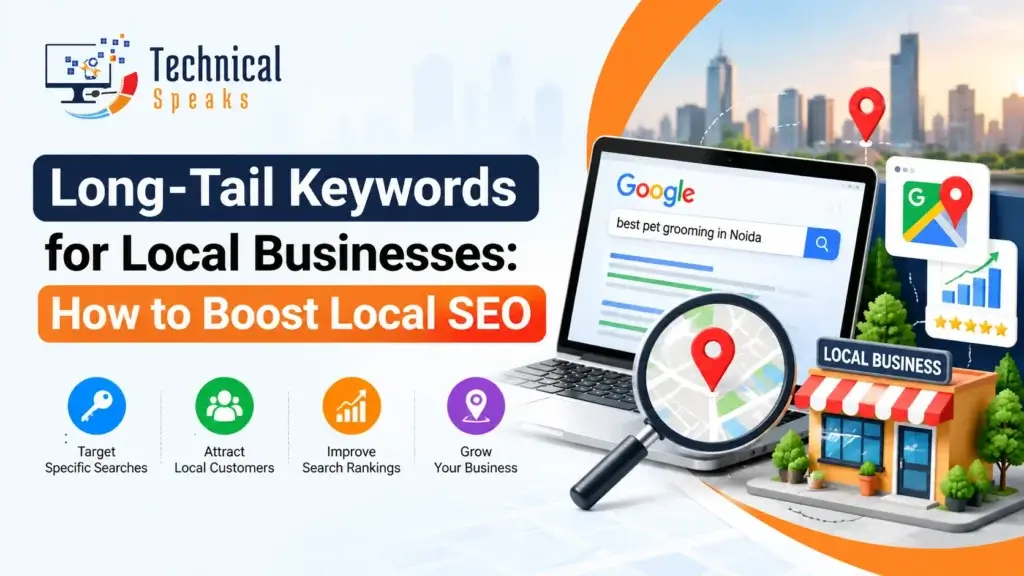
If you run a local business, broad keywords like “plumber” or “dentist” are hard to win. Nearby customers usually search with longer, clearer phrases: “emergency plumber in North Lakes,” “gluten-free birthday cake pickup Seattle,” or “kids dentist open Saturday in Austin.”
Those longer phrases are long-tail keywords. They’re more specific, often less competitive, and closer to a call, booking, or visit. This guide shows how to find them, put them on the right pages, and shape them for both organic rankings and AEO (answer engine optimization).
What are long-tail keywords?
A long-tail keyword is a specific search phrase, usually three or more words, with a clear intent. “Head” terms are short and broad. The “tail” is full of narrower queries.
For local businesses, long-tail keywords often mix:
- a service or product
- a place (city, suburb, landmark)
- a qualifier (emergency, near me, price, open now, for kids)
Someone searching “shoes” may only be browsing. Someone searching “size 10 waterproof hiking boots Brisbane CBD” is much closer to buying.
Why they matter for local SEO
You rarely need to beat national brands for one-word terms. You need to win the phrases your real customers type.
Long-tail keywords help because:
- Intent is clearer, so traffic is usually more useful
- Competition is often lighter than head terms
- They fit location pages, service pages, FAQs, and Google Business Profile text
- They match how people ask AI tools for recommendations
If you want the bigger picture of why local visibility matters, see local SEO benefits.
Types of local long-tail keywords
Use a mix, not only one pattern:
- Service + city/suburb — “dental cleaning in Indiranagar”
- Near me — “bakery near me open now”
- Emergency / urgent — “24 hour locksmith Ghaziabad”
- Audience + service — “preschool for working parents Raj Nagar Extension”
- Problem + place — “blocked drain repair Fortitude Valley”
- Comparison / commercial — “best keratin treatment Boston”
- Question form — “how much does a house cleaning cost in Pune”
Question-style phrases are especially useful for FAQs and AEO.
How to find long-tail keywords (free first)
Start with Google before paid tools.
- List your main services
- Add your city, suburbs, and nearby landmarks
- Type those seeds into Google and note Autocomplete suggestions
- Check People Also Ask
- Scroll to Related searches
- Write down questions customers ask on calls, WhatsApp, or reviews
- Look at competitors’ service page titles and FAQs with a light SEO competitor analysis
Optional tools (Ubersuggest, Keyword Planner, Ahrefs, Semrush) can help you spot extras. You don’t need exact volume numbers to start — clarity and fit matter more than chasing a big number.
Map keywords to the right pages
Don’t dump every phrase on the homepage.
| Keyword type | Best home |
|---|---|
| Main service + city | Core service or location page |
| Suburb-specific demand | Only if you truly serve that area — one honest page |
| Questions | FAQ block or supporting blog |
| Offers / seasonal | GBP posts + short site updates |
| Brand + location | Homepage / about |
One clear intent per page beats ten thin location pages with the same text. For structure help, use an on-page SEO checklist.
Where to place long-tail keywords naturally
- Title tag and H1 (one primary idea)
- First paragraph in plain language
- Subheadings that sound like real questions
- FAQ answers
- Image alt text when it’s genuinely descriptive
- Internal links with clear anchors
- Google Business Profile services, description, and posts (monetize Google Business Profile)
Write for people first. If a sentence only exists to repeat a keyword, cut it.
Optimize for AEO as well as Google
Organic SEO helps you rank. AEO helps AI systems cite or recommend you.
With long-tail topics:
- Answer the question in the first 2–3 sentences
- Use simple Q&A blocks
- Add accurate LocalBusiness details (address, hours, service area)
- Keep NAP consistent with your profile
- Write the way people talk to assistants: “Where can I find…”, “Who is best for…”
For the wider method, see AI answer engines: how to get cited. Local recommendation prompts also show up in SEO trends for 2026.
Simple examples by business type
- Cafe: “quiet cafe with wifi in Koramangala”
- Plumber: “emergency water heater repair in Round Rock”
- Salon: “bridal hair trial Boston Near Back Bay”
- Preschool: “daycare preschool in Raj Nagar Extension”
- Clinic: “same day pediatrician appointment in Noida”
Each one can become a section, FAQ, or focused page — not a keyword stuffed into the business name.
Common mistakes
- Stuffing suburbs into your Google Business name
- Making duplicate pages for areas you don’t serve
- Chasing only high-volume terms
- Ignoring reviews and GBP while only editing blogs
- Buying random links instead of earning high-quality backlinks
- Publishing once and never updating
New sites should get foundations right first: SEO for a new website.
A simple weekly workflow
- Pick one service
- Gather 10–15 long-tail phrases from Google + customer questions
- Choose one primary phrase for the page
- Rewrite the intro as a direct answer
- Add 3 FAQs people actually ask
- Link to related guides on your site
- Update the matching GBP service/category if needed
Frequently asked questions
Are long-tail keywords still worth it in 2026?
Yes. People still search in specific phrases, and AI tools often answer those same detailed questions.
Should I target “near me” on my website?
You can mention it in FAQs when it sounds natural. Google often personalizes “near me” by location, so strong GBP data and clear service-area pages matter as much as the words on the page.
How many long-tail keywords per page?
One primary idea, then a few closely related phrases. Don’t turn the page into a list of suburbs.
Do long-tail keywords help with ChatGPT or Perplexity?
They help when your content clearly answers the same questions people ask those tools — with facts, location details, and clean structure.
Final thoughts
Long-tail keywords are how local customers describe what they need. Find the phrases they already use, put each one on the right page, and answer in plain language. That supports classic local rankings and gives answer engines something solid to cite.
Start with one service, one location focus, and one improved page. Then build out the cluster with useful internal links.
About the author
Saurabh K. has been working in SEO and digital marketing for 10+ years, helping businesses grow their search traffic.