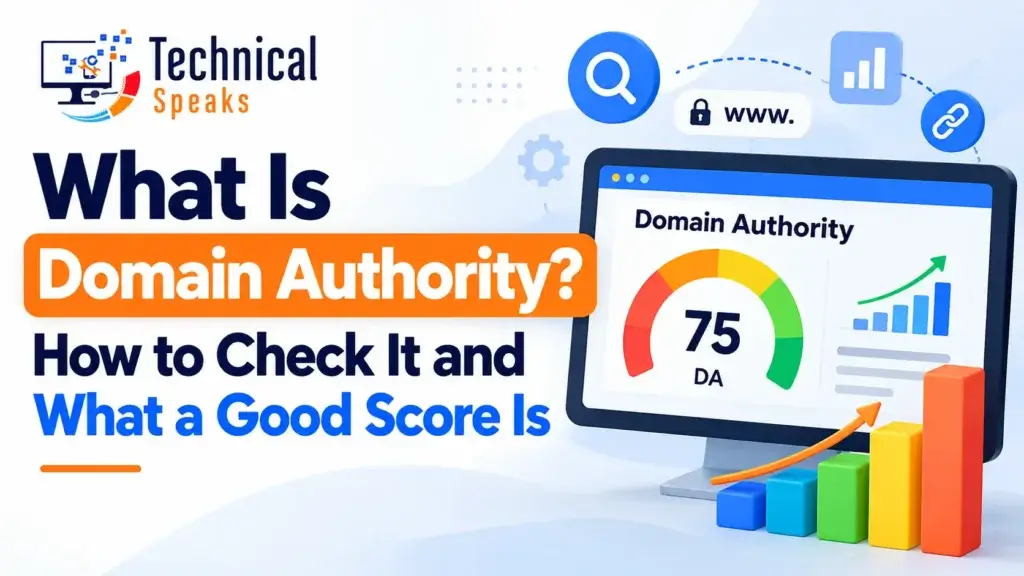
Domain Authority (DA) is a score from 1 to 100, created by the SEO software company Moz, that estimates how strong a website’s backlink profile is compared with other sites. Higher scores suggest a better chance of ranking, but Google doesn’t use DA at all.
That last part trips up a lot of people. DA is a handy comparison tool, not a ranking factor. Use it to size up competitors and link opportunities, not as a goal on its own.
This guide explains what DA measures, how to check it for free, what a “good” score looks like, and what actually moves it.
What is Domain Authority?
Domain Authority is Moz’s prediction of how likely a whole domain is to rank, based mainly on the links pointing to it.
- Scale: 1 to 100
- Made by: Moz, not Google
- Based on: link data, mainly how many unique websites link to you and how strong those sites are
- Scale type: logarithmic, so going from 20 to 30 is much easier than going from 70 to 80
Because it’s a prediction built on Moz’s own link index, your DA can change even when nothing on your site changes.
Does Google use Domain Authority?
No. Google has said many times that it doesn’t use third-party scores like DA, DR or Authority Score.
So why does anyone care? Because DA is built from links, and links do still matter in Google’s ranking systems. DA is a rough reflection of something real. It just isn’t the thing itself.
Think of it like a credit score from a private agency: useful for comparison, but the bank makes its own decisions.
For more on how Google actually ranks pages, see Google algorithms for SEO success.
How is Domain Authority calculated?
Moz uses a machine-learning model trained on its link data. You can’t calculate DA by hand. The main inputs are:
- Linking root domains: how many different websites link to you
- Quality of those linking sites: links from strong, trusted sites count more
- Total links: less important than the number of unique sites
- Spam patterns: links that look manipulative can be discounted
Things that are not direct DA inputs: domain age, page speed, mobile-friendliness, keywords and social shares. They can still help your rankings and make people more likely to link to you, which is how they affect DA indirectly.
How to check Domain Authority (free and paid)
1. Moz Link Explorer and Domain Analysis
This is the official source.
- Go to Moz’s Link Explorer or free Domain Analysis tool
- Enter the domain
- See DA, linking root domains, top linking sites and Spam Score
Free use is limited, but it’s enough for a quick check.
2. MozBar (Chrome extension)
MozBar shows DA and Page Authority (PA) for any site you visit and in search results. It’s great for quick competitor checks while you browse Google.
3. Similar metrics from other tools
These aren’t DA, but they measure a similar idea:
- Ahrefs Domain Rating (DR): 0–100, based purely on backlink strength. Ahrefs has a free Website Authority Checker
- Semrush Authority Score (AS): 0–100, mixes backlinks, organic traffic and spam signals
- Ubersuggest: shows its own authority score, not Moz’s DA
Many free “DA checker” sites pull Moz data through its API. They’re fine for a quick look, but check important numbers in Moz itself.
DA vs PA vs DR vs Authority Score
| Metric | Made by | Measures | Scale |
|---|---|---|---|
| Domain Authority (DA) | Moz | Ranking potential of a whole domain, based on links | 1–100 |
| Page Authority (PA) | Moz | Ranking potential of a single page | 1–100 |
| Domain Rating (DR) | Ahrefs | Backlink profile strength of a domain | 0–100 |
| Authority Score (AS) | Semrush | Links plus traffic and spam signals | 0–100 |
Don’t compare a DA from one tool with a DR from another. Pick one metric and use it consistently.
What is a good Domain Authority score?
There’s no universal “good” number. DA is relative, so a good score is one that’s competitive in your niche.
- A new local bakery site might have DA 5–15, and so might its competitors
- A national news site might sit at 90+
What to do instead of chasing a number:
- Search your main keywords
- Check the DA of the sites ranking on page one
- If yours is close, you can compete with better content and targeting
- If yours is far lower, target longer, more specific keywords first
This fits naturally into an SEO competitor analysis.
Why did my Domain Authority drop?
A DA drop doesn’t always mean you did something wrong. Common reasons:
- Moz updated its index or model, and scores shifted across the web
- You lost backlinks (pages deleted, links removed)
- Competitors and big sites gained links, so your relative position fell
- Low-quality links were discounted
Check your rankings and organic traffic in Google Search Console. If they’re stable, a DA dip isn’t a crisis.
How to improve Domain Authority (the short version)
Since DA is mostly about links, improving it means earning better links over time:
- Create link-worthy content: original data, useful guides, free tools, case studies
- Earn relevant backlinks: guest contributions on niche sites, digital PR, partner and supplier links. See how to create high-quality backlinks
- Reclaim unlinked mentions: ask sites that mention your brand to add a link
- Fix broken pages with links pointing to them: redirect them to the closest live page
- Build a strong internal structure so authority flows to important pages. See content clusters and pillar pages
For the full step-by-step method, read how to boost domain and page authority.
What not to do:
- Don’t buy link packages or join link schemes. They can lead to Google penalties. See black hat SEO techniques to avoid
- Don’t disavow links just to “raise DA.” Google says most sites never need the disavow tool, and it doesn’t change Moz’s score. It’s mainly for manual actions or past paid-link problems. If that’s you, see how to recover from a Google penalty
Also keep the basics solid, because they help you rank and earn links: the on-page SEO checklist and these common technical SEO mistakes.
Domain authority vs topical authority
Domain Authority measures link strength across your whole site. Topical authority is about how deeply and reliably you cover one subject.
A smaller site with excellent, well-linked coverage of one topic can outrank a high-DA site that only touches it once. That’s why niche blogs regularly beat big publishers on specific searches.
Does DA matter for AI answer engines?
Not directly. ChatGPT, Perplexity and Google AI Overviews don’t check DA scores.
What tends to help you get cited:
- Clear, answer-first content
- Mentions and citations on trusted sites
- Consistent brand and entity information
- Deep coverage of your topic
Learn more about how answer engine optimization works and how to get cited by AI answer engines.
Common Domain Authority myths
- Myth: DA is a Google ranking factor. Reality: Google doesn’t use it.
- Myth: High DA guarantees high rankings. Reality: relevance, intent and content quality still decide who ranks for a specific search.
- Myth: Buying backlinks is a quick DA boost. Reality: spammy links get discounted and can trigger penalties.
- Myth: DA is the only metric that matters. Reality: organic traffic, rankings, leads and revenue matter far more.
Real-world example
Say you run a travel blog with DA 25, and a competitor has DA 50.
If you both write “Best Places to Visit in Italy,” they’ll probably win. That’s a broad, competitive search, and they have a stronger link profile.
But if you write “Budget-friendly things to do in Rome with kids,” a specific, well-researched guide can outrank them. Fewer strong sites compete for it, and your page matches the intent better.
Lesson: use DA to pick your battles, then win them with relevance and quality.
How to use DA in your SEO work
- Competitor research: see how your link strength compares
- Link prospecting: prioritise relevant sites with real traffic, using DA only as one filter
- Progress tracking: watch the trend over months, not week-to-week swings
- Client reporting: show DA alongside traffic and conversions, never on its own. See how to create SEO reports for clients
You can track most of this with these free SEO tools.
Frequently asked questions
What is Domain Authority in simple words?
It’s a 1–100 score from Moz that estimates how strong a website’s backlink profile is compared with other sites.
Is Domain Authority a Google ranking factor?
No. Google doesn’t use DA. It’s a third-party metric that roughly reflects link strength.
How can I check Domain Authority for free?
Use Moz’s free Domain Analysis tool, Link Explorer (with limited free searches) or the MozBar Chrome extension.
What is a good Domain Authority?
One that’s competitive with the sites ranking for your target keywords. Compare yourself with your niche, not with Wikipedia.
How long does it take to increase Domain Authority?
Usually several months to a year or more of steady, quality link earning. Higher scores take longer to grow.
What’s the difference between DA and DR?
DA is Moz’s metric and DR is Ahrefs’. Both use 0–100 scales built on links, but they’re calculated differently, so don’t compare them directly.
Final thoughts
Domain Authority is a useful yardstick, not a goal. It helps you compare sites, spot link opportunities and pick keywords you can realistically win.
Focus on what DA reflects: real links from relevant sites, earned through content people want to reference. Do that, and your rankings, traffic and DA will tend to rise together.
For the bigger picture, read our web search engine positioning guide and rank #1 on Google SEO strategies. Starting fresh? Begin with SEO for a new website, and see what’s changing in SEO trends 2026.
About the author
Saurabh K. has been working in SEO and digital marketing for 10+ years, helping businesses grow their search traffic.