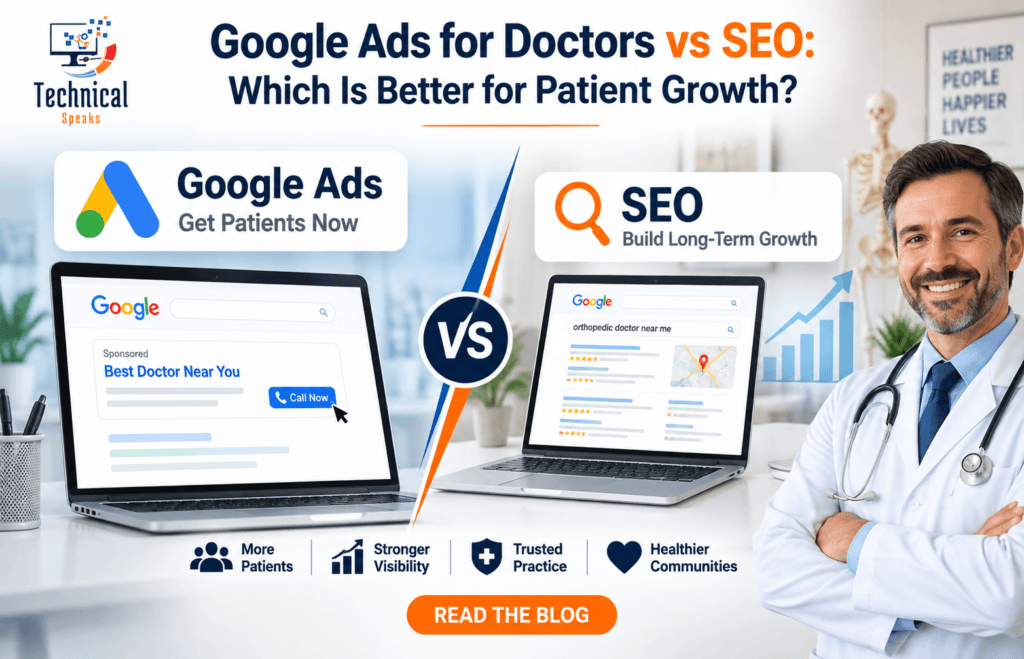
When it comes to digital marketing in healthcare, few debates are as heated as Google Ads for Doctors versus organic search engine optimization (SEO). Understanding Google algorithms for SEO is essential when building a strong organic strategy, as these algorithms influence how medical websites rank in search results. Both strategies promise to fill your appointment books, but they work in fundamentally different ways—and choosing the wrong one can cost you thousands in wasted ad spend or months of lost visibility. In this guide, we’ll break down exactly how each channel performs for medical practices, compare their costs, timelines, and patient quality, and help you decide which approach (or combination) will drive sustainable patient growth for your specialty.
The Core Difference: Speed vs. Sustainability
At its simplest, Google Ads for Doctors is a paid traffic strategy that puts your practice at the top of search results immediately—as long as you’re willing to bid on relevant keywords like “orthopedic surgeon near me” or “pediatrician accepting new patients.” SEO, on the other hand, is an organic strategy that builds authority over time through optimized content, backlinks, and technical website improvements.
Think of it this way:
Google Ads = renting visibility (you pay per click, and traffic stops when the budget runs out).
SEO = owning visibility (you invest upfront, and traffic compounds over months or years).
Both can deliver high-intent patients, but their timelines, costs, and ROI profiles are vastly different. Let’s dive into the specifics.
How Google Ads for Doctors Works (and When It Shines)
Google Ads for Doctors operates on a pay-per-click (PPC) model. You create campaigns targeting specific keywords, geographic areas (e.g., within 10 miles of your clinic), and even time-of-day when patients are most likely to search. Your ad appears above organic results with a small “Ad” label, and you pay only when someone clicks.
Pros of Google Ads for Doctors:
Instant visibility—Your ad can go live within hours, not months.
Precise targeting—Filter by location, device, demographics, and even previous website visitors (retargeting).
Budget control—Set daily caps; pause anytime.
A/B testing—Test different headlines, offers, and landing pages in real time.
High-intent traffic—Patients searching “emergency dentist open now” are ready to book.
Cons of Google Ads for Doctors:
Costly in competitive specialties—CPCs for “plastic surgeon” or “fertility clinic” can exceed $50–$100 per click.
Short-lived results—Turn off the budget, and you disappear from page one.
Click fraud risk—Competitors or bots can drain your budget (though Google offers some protection).
Requires constant optimization—poorly managed campaigns waste money fast.
Best Use Cases for Google Ads:
New practices needing immediate patient flow.
Promoting seasonal services (e.g., flu shots, LASIK specials).
Testing new service lines before committing to SEO content.
Competing in saturated markets where organic ranking is years away.
How SEO for Doctors Works (and When It Outperforms)
SEO for medical practices involves optimizing your website so that Google ranks it naturally for relevant searches. This includes on-page content (blog posts, service pages), technical fixes (site speed, mobile-friendliness), local SEO (Google Business Profile, citations), and off-page signals (backlinks from authoritative health sites).
Pros of SEO:
Compounding returns—A well-ranked article can bring patients for 2–3+ years with minimal upkeep.
Higher trust—Patients often perceive organic results as more credible than ads.
Cost-per-acquisition drops over time—After the initial investment, each new patient costs nearly zero in click fees.
Synergy with ads – Organic presence improves your quality score, lowering your ad CPC.
Cons of SEO:
Slow ramp-up—Typically 4–9 months before seeing meaningful traffic (longer in competitive niches).
Algorithm risk—Google updates can wipe out rankings overnight (though less common for high-authority medical sites).
No guaranteed results—Even with best practices, you may not outrank established hospital systems.
Ongoing content investment—Requires regular blogging, link-building, and technical maintenance.
Best Use Cases for SEO:
Established practices with a 6–12 month runway.
Specialties with high lifetime value (e.g., orthodontics, chronic care).
Local practices wanting to dominate “near me” searches.
Practices that produce patient education content (which also improves bedside trust).
Head-to-Head Comparison: 7 Key Metrics
| Metric | Google Ads for Doctors | SEO for Doctors |
|---|---|---|
| Time to first patient | 1–3 days | 3–9 months |
| Monthly cost (medium competition) | $2,000–$10,000+ | $1,500–$5,000 (after initial setup) |
| Cost per new patient | $150–$600+ (varies by specialty) | $50–$250 (after 6+ months) |
| Patient intent | High (transactional) | Mixed (informational + transactional) |
| Scalability | Linear—pay more, get more clicks | Exponential—one article can rank for dozens of keywords. |
| Control | Full control over messaging and budget | Limited control over ranking position |
| Trust factor | Lower (some patients skip ads) | Higher (perceived as “earned” visibility) |
The Real Question: Which One Grows Your Practice Faster?
The answer depends entirely on your practice’s current situation. Let’s break it down by scenario:
Scenario A: Brand-New Practice (0–6 months old)
Winner: Google Ads for Doctors
You cannot wait 9 months for SEO to kick in. You need patients now to cover overhead, build a referral base, and generate reviews. Run a lean PPC campaign targeting high-intent, long-tail keywords (e.g., “same-day sick visit clinic [city]”) while simultaneously starting SEO work in the background.
Scenario B: Established Practice (2+ years) with Steady Cash Flow
Winner: SEO (with minimal ad spend)
Once you have a financial cushion, invest heavily in content and local SEO. The long-term ROI crushes PPC. Use ads only for new service launches or seasonal promotions.
Scenario C: High-Competition Specialty (e.g., Cosmetic Surgery, Fertility)
Winner: Both—but strategically
CPCs are so high that relying solely on ads is unsustainable. Use SEO to build authority on non-branded informational keywords (e.g., “how to choose a tummy tuck surgeon”) while using ads to capture branded and high-commercial-intent searches. This hybrid approach lowers your overall cost per acquisition.
Scenario: D: Rural or Underserved Area
Winner: SEO (almost exclusively)
With fewer competitors, you can rank organically for “city + specialty” within 3–4 months. Ads may be cheaper too, but organic dominance gives you a permanent moat.
The Hidden Synergy: Why You Shouldn’t Choose Just One
Here’s the secret most marketing agencies won’t tell you: Google Ads for Doctors and SEO are not enemies—they are force multipliers.
Ads fund SEO—Profits from PPC can pay for content writers, link-building, and technical audits.
SEO improves Ad Quality Score—Relevant, fast-loading landing pages with strong organic content get lower CPCs.
Remarketing bridges the gap—Users who find you via organic search but don’t convert can be retargeted with display ads.
Data sharing—PPC keyword data reveals which search terms convert best, informing your SEO content strategy.
In practice, the most successful medical practices allocate 60–70% of their digital budget to SEO and 30–40% to Google Ads, adjusting based on seasonality and practice goals.
Cost Breakdown: What to Budget
Google Ads for Doctors (Monthly):
Small practice (low competition): $1,500–$3,000 (50–100 clicks/month)
Mid-size practice (moderate): $4,000–$8,000 (150–300 clicks)
Large/competitive specialty: $10,000–$25,000+ (400+ clicks)
Plus: Landing page design ($500–$2,000 one-time) + management fee (15–20% of ad spend).
SEO for Doctors (Monthly):
Local SEO only (GBP optimization, citations): $500–$1,500
Content + on-page (4–8 blog posts/month): $2,000–$4,000
Full-service (content + technical + link-building): $4,000–$10,000
Plus: Initial site audit ($1,000–$3,000) and possible redesign ($5,000–$15,000).
Pro tip: Start with a $3,000/month SEO retainer and a $2,000/month Google Ads budget. After 6 months, review which channel delivers better-quality patients (not just volume) and reallocate accordingly.
Patient Quality: Which Brings Better-Appointed Patients?
Not all patients are equal. A patient who clicks an ad for “emergency root canal” is in pain and likely to book immediately—but may be price-sensitive and less loyal. A patient who finds your 2,000-word guide on “root canal aftercare” via organic search has done their research, trusts your expertise, and is more likely to accept your treatment plan and refer others.
Data point: A 2023 study by PatientPop found that organic-sourced patients had a 22% higher lifetime value than ad-sourced patients across 5,000+ medical practices. However, ad-sourced patients converted 3x faster in the first 30 days.
So if you need cash flow now, run ads. If you want a loyal patient base that stays for years, invest in SEO.
Common Mistakes to Avoid
With Google Ads:
Bidding on broad-match keywords (“doctor”)—wastes budget on irrelevant searches.
Sending traffic to your homepage instead of a dedicated, mobile-optimized landing page.
Ignoring negative keywords (e.g., “jobs,” “salary,” “school”)—filter out non-patients.
Not tracking phone calls—many medical conversions happen offline.
With SEO:
Writing generic content that doesn’t answer real patient questions (use “People Also Ask” and forums).
Neglecting local SEO—without a complete Google Business Profile, you lose “near me” searches.
Ignoring page speed—a 1-second delay reduces conversions by 20% in healthcare.
Expecting results without link-building—on-page content alone rarely ranks in competitive cities.
The Verdict: Which Is Better for Patient Growth?
There is no single winner—but here’s a rule of thumb:
If you need patients in the next 30 days, choose Google Ads for Doctors. If you want sustainable, lower-cost growth over 12+ months, prioritize SEO and effective Google ranking strategies. For most practices, the optimal strategy is a 40/60 split – ads for immediate wins, SEO for long-term dominance.
The smartest medical marketers treat Google Ads as their accelerator and SEO as their engine. The accelerator gets you moving quickly, but the engine keeps you running far after the fuel runs out.
Final Recommendation: Your 12-Month Roadmap
Months 1–3:
Launch Google Ads with a $3,000–$5,000 monthly budget targeting high-intent, long-tail keywords.
Simultaneously conduct an SEO audit and create 4 cornerstone content pieces (each 2,000+ words) on your top service lines.
Months 4–6:
Optimize ads based on conversion data (pause underperforming keywords, test new ad copy).
Begin local link-building (partner with local health blogs and chambers of commerce).
Publish 2–3 blog posts per week addressing patient FAQs.
Months 7–9:
Organic traffic should start rising. Reduce ad spend by 10–20% and redirect to SEO.
Implement retargeting ads for visitors who consumed your SEO content but didn’t book.
Months 10–12:
By now, SEO should deliver 40–60% of new patients.
Maintain ads for competitive keywords and seasonal promotions.
Re-evaluate—if SEO is outperforming, shift more budget; if ads are still king, keep the balance.
Next Steps for Your Practice
Run a 7-day Google Ads test with $500 to gauge CPC and conversion rates for your top 5 keywords.
Audit your current organic visibility using tools like Semrush or Ahrefs—check which pages already rank on pages 2–3.
Calculate your patient lifetime value—if it’s over $5,000, SEO almost always wins on ROI.
Consider a hybrid agency that specializes in healthcare—they’ll manage both channels without siloing data.
Ultimately, the question isn’t “Google Ads for Doctors vs. SEO”—it’s “How quickly do you need patients, and how much are you willing to invest in long-term equity?” The practices that thrive in 2026 and beyond will use both, not as alternatives, but as complementary gears in a single patient-acquisition machine.