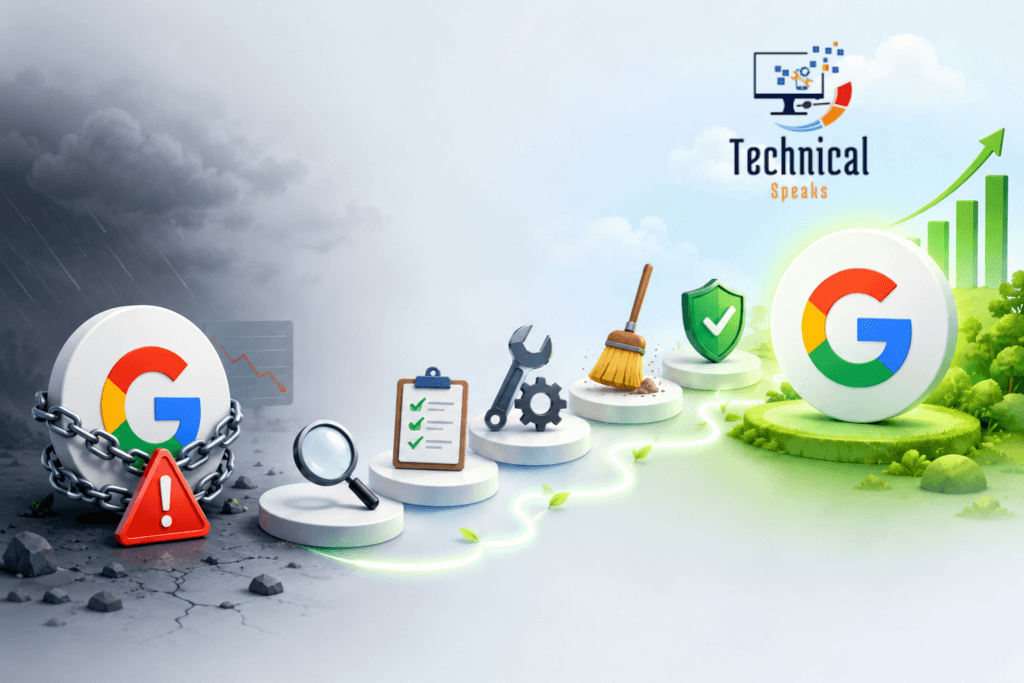
Then one day you wake up, check your site analytics and your heart sinks. Organic traffic down 80% overnight. Google has almost completely stopped showing your once thriving website in its search results. Usually, this nightmare scenario is due to a Google penalty.
The good news? Many of the penalties related to google penalty in SEO are reversible. The bad news is… Recovery takes time and measured steps. In this guide, I’ll walk you through, step by step, how to diagnose, fix, and recover from Google penalties — both manual and algorithmic — so you can restore your rankings and improve your website’s long-term SEO performance.
What Is a Google Penalty?
A “Google penalty” is when a website’s search rankings are negatively impacted because the website violates Google’s Webmaster Guidelines. There are usually two kinds of penalties:
Manual Action
A human reviewer at Google has determined that your site is not compliant with Google’s quality guidelines. You receive a message in Google Search Console.
Algorithmic Penalty
An automated algorithm (Panda, Penguin, or a core update) downgrades your site. No manual action is reported, you just lose rankings.
Some common triggers include:
- Unnatural backlinks
- Thin or duplicate content
- Keyword stuffing
- User-generated spam
- Hacked content
- Poor user experience signals
The Importance
It’s not just about getting your traffic back from a penalty – it’s about saving your business. Here’s why you can’t ignore it:
Lost Revenue
For many businesses, organic search is their number one customer acquisition channel. Penalty that kills sales and leads dead.
Brand Awareness
If you disappear from Google, you will lose trust and brand awareness. Customers often associate top rankings with credibility.
Long-Term Damage
If a penalty remains uncorrected, it can cause problems in the long run. Google may still distrust your domain which can affect your future efforts to build links and content.
Cost of Alternatives
Without organic traffic, you will depend on paid ads and social media – which can be more expensive and less sustainable.
A penalty is not something you can ignore. The quicker you act, the sooner you will be able to get your online presence back.
A Step-by-Step Guide
Do these seven steps in order. Rushing or skipping steps will slow recovery.
Step 1: Determine the Type of Penalty
Check Google Search Console (GSC) → “Security & Manual Actions” tab. If a manual action exists, you’ll see details about the issue that’s violating our guidelines (for example, “Unnatural links to your site”).
Traffic dropped but no manual action? Probably algorithmic. Use a tool such as MozCast or RankRanger to verify the dates of major Google updates (Panda, Penguin, Core Updates). Align to your traffic drop date.
Step 2: Identify the Real Problem
For Manual Linking Penalties
Import your backlinks from GSC. Find out which links are toxic (spammy directories, low-quality forums, paid links). Also check your anchor text distribution – over-optimized exact match anchors are a red flag.
Content Related Penalties (Panda/Manual)
Crawl your site with Screaming Frog or Sitebulb. Pages containing:
- Short word count (<300 words)
- Duplicate content (same meta descriptions, product descriptions etc.)
- High bounce rates and low time on page
- Content scraped or auto-generated
For Spam Created by Users (Manual)
Look at comment sections, forums or profile pages that are full of casino, pharmacy or porn links.
Step 3: Developing a Remediation Plan
Just list all the bad things according to your diagnosis:
- Toxic backlink URLs
- Improve or remove thin content pages
- Keyword-stuffed internal anchor links
- Hacked or malware infected pages (scan with Sucuri)
Focus on issues that directly relate to the penalty reason. 90% of your link penalty efforts should be link removal/disavow.
Step 4: Solve the Problems
For Penalties of Links
- Contact the webmasters of harmful referring domains and request link removals as part of your strategy for improving rankings through google algorithms for SEO success. Keep a detailed spreadsheet that includes outreach dates, email copies, follow-up attempts, and responses received from each domain owner.
- No response after 2-3 tries? Create a “disavow file” with the domains. Only use Google’s Disavow Tool after you’ve tried everything you can to get links removed naturally.
- Remove unnatural outbound links from your own site (i.e. paid links or too many affiliate links).
For Content That is Penalized
- Thin pages can be improved with original research, images, videos, and useful details. Write a 500-700 word substantive essay.
- Duplicate pages with no unique value should be removed or no-indexed. Combine all similar posts into one mega-guide.
- Remove keyword stuffing from headings, titles and body text. Naturally write for users.
For Hacked Sites
- Clean your site using a security plugin or a professional service.
- Cleaning done. Requesting review in GSC.
Step 5: Request a Reconsideration (Manual Penalties Only)
Fix everything and go to GSC → Manual Actions → Request Review. Write an effective reconsideration letter.
Include These Points:
- Clearly admit the violation (e.g. “We bought low quality backlinks”)
- List all actions taken in detail (with dates and evidence) (e.g. “Removed 150 toxic backlinks, disavowed another 300 domains”)
- Explain how you will avoid future violations (e.g., “We now audit all guest posts and use a no-follow tag for sponsored links”)
Be honest. Be complete. Partial fixes or vague explanations risk rejection.
Step 6: Algorithmic Recovery (No Reconsideration Necessary)
Your site has to be re-crawled and re-evaluated by Google with algorithmic penalties. Do not submit a reconsideration request (that’s only for manual actions). Instead:
- Produce quality unique content on a consistent basis.
- Get or build natural backlinks from relevant, reputable websites.
- Improve Core Web Vitals and mobile experience.
Algorithmic recovery can take weeks or months. The next core update, for instance, is the next version of that algorithm that will re-evaluate your site.
Step 7: Check Progress and Wait
Your fixes and reconsideration request (if applicable) after:
- Check GSC weekly for messages of rejection or approval. If rejected, read the reason carefully and correct what was missed.
- Track organic traffic in Google Analytics. Manual penalties can take 2-6 months to fully recover from. Algorithmic penalties can take 1-3 algorithm updates.
Frequent Errors
Even seasoned site owners fall into these traps:
- Using the disavow tool too much without trying to remove links first. Google wants you to attempt removal before disavowing.
- To treat the symptom, not the disease. Example: Removing a low-value page, but still posting low-value content on other pages.
- Too early to file reconsideration request. Wait until you have done every fix and have proof of it.
- Not paying attention to the rest of the site. Google may still deny your request if you only fix 80% of the issues.
- Using automated services to “clean” backlinks – they often make things worse by reporting legit links as toxic.
Tips from the Pros
- Maintain a recovery journal with dates, actions and screenshots. You’ll need it for your reconsideration request and for your sanity.
- Always delete or merge content in a staging environment to prevent breaking live site navigation.
- If you’re penalized, stop all outreach and link building until you’re back in shape. New unnatural links during recovery will harm your case.
- Go to Google and do a “site:yourdomain.com” search. You will often find pages that Google has indexed but you forgot about – audit those too.
- Set up rank tracking for your top 10 money keywords. You will see when the recovery starts (even before GSC updates).
Common Questions
Q: How long is the recovery period?
A: 2-4 weeks after manual penalties reconsideration approval. For algorithmic, 1-6 months, based on the next algorithm update cycle.
Q: Can I hide pages from Google instead of fixing them?
A: No index is fine for pages that have no value. But if the penalty is site wide (eg thin content across the domain) then you need to fix/remove enough pages to change the overall site quality.
Q: Does a penalty expire on its own?
A: Manual penalties never time out. They remain until you resolve the issue and ask for a review. Algorithmic penalties are only lifted when your website gets better and Google updates the algorithm.
Q: I bought backlinks before. Can I recover?
A: Sure, if you get rid of and disavow those links, and stop buying links from now on. Many sites have fully recovered.
Q: Does a penalty affect the entire website?
A: Link penalties are often site-wide. Content penalties can be either site-wide (Panda) or page-specific (thin content manual action). Check GSC manual action details.
Conclusion
Getting out of a Google penalty is not quick, but it is certainly possible. The process is straightforward: find the penalty, correct every infraction sincerely, and request a review (for manual actions). Don’t cut corners, and don’t expect overnight results.